Grand Archive Tournament

Weekly Grand Archive at Gnome Games Green Bay West

Entry: $7
This is a 3 round, win a match – win a pack tournament.

Everyone gets a promo pack just for participating!

Players should create your profile on the Omnidex before arriving at the event so registration goes smoothly.
https://omni.gatcg.com/

Friday Night Dungeons and Dragons

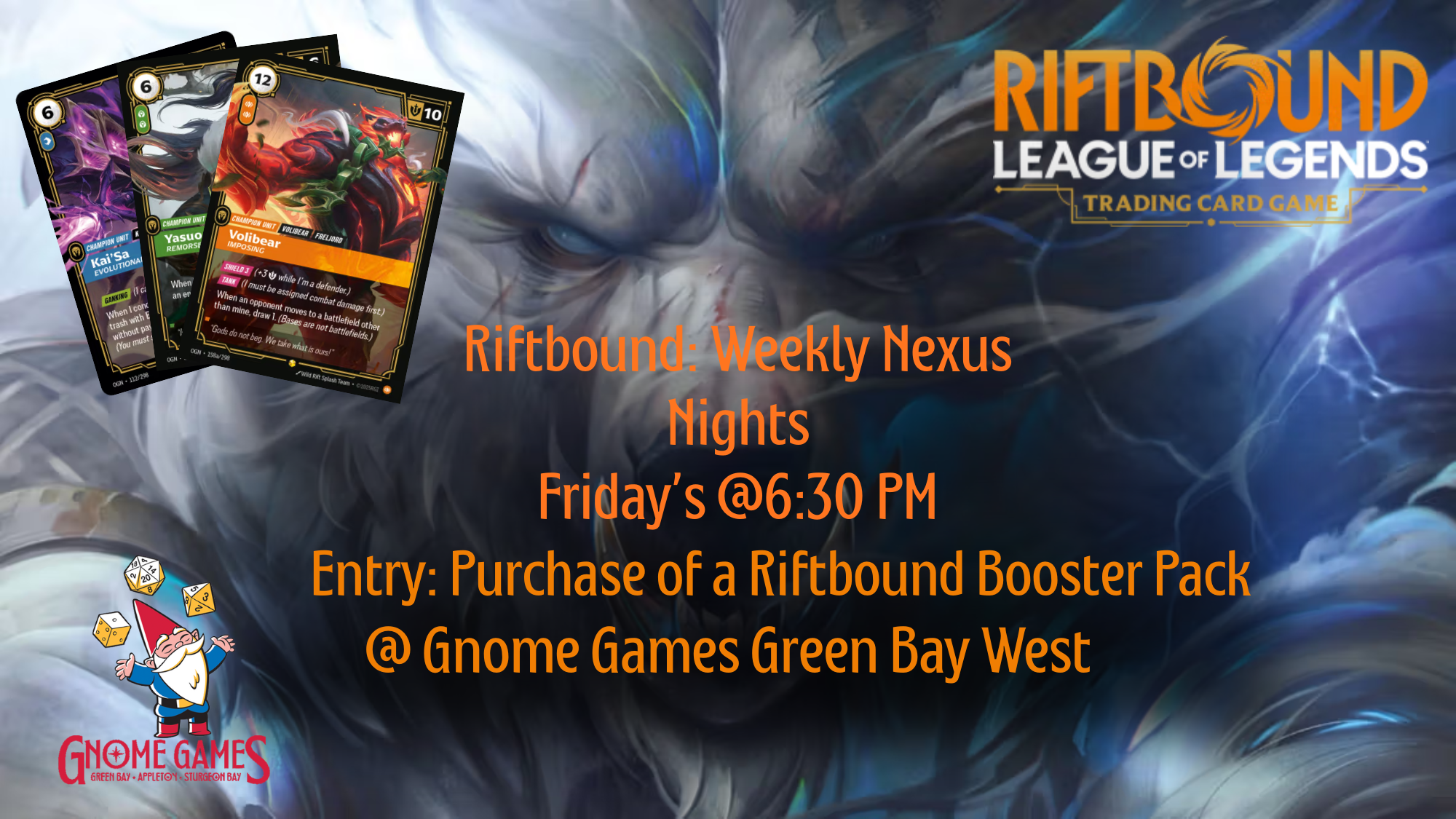
Dungeons and Dragons is on Fridays at Gnome Games Green Bay West!

Fridays at 6pm we’ll have a Dungeon Master (DM) here to run a table of D&D from 6pm – 8:00pm! Table fees are $10. There are limited seats available for the Gnome DM, but we can supply an additional adventure to a valiant DM who will run for additional players.

These are perfect events for brand new or recent players to join. Our adventures will frequently focus on helping new players join D&D!

Pregenerated Characters will be available: D&D Character Sheets | Dungeons & Dragons (wizards.com) for previews of some of the 1st level characters that will be available.

Bring your own dice or purchase a set when you come in! Are you ready to join the table?

There are a number of great resources for helping new players and new GMs learn Dungeons and Dragons! Here are a few:

How to Play | Dungeons & Dragons (wizards.com)
Some playlists of YouTube videos for 1st time players:
Ginny Di: 28! videos on various tips and ways to play.
Dungeon Dudes: 20 videos on Character Creation.

Friday Night Dungeons and Dragons

Dungeons and Dragons is on Fridays at Gnome Games Green Bay West!

Fridays at 6pm we’ll have a Dungeon Master (DM) here to run a table of D&D from 6pm – 8:00pm! Table fees are $10. There are limited seats available for the Gnome DM, but we can supply an additional adventure to a valiant DM who will run for additional players.

These are perfect events for brand new or recent players to join. Our adventures will frequently focus on helping new players join D&D!

Pregenerated Characters will be available: D&D Character Sheets | Dungeons & Dragons (wizards.com) for previews of some of the 1st level characters that will be available.

Bring your own dice or purchase a set when you come in! Are you ready to join the table?

There are a number of great resources for helping new players and new GMs learn Dungeons and Dragons! Here are a few:

How to Play | Dungeons & Dragons (wizards.com)
Some playlists of YouTube videos for 1st time players:
Ginny Di: 28! videos on various tips and ways to play.
Dungeon Dudes: 20 videos on Character Creation.

Friday Night Dungeons and Dragons

Dungeons and Dragons is on Fridays at Gnome Games Green Bay West!

Fridays at 6pm we’ll have a Dungeon Master (DM) here to run a table of D&D from 6pm – 8:00pm! Table fees are $10. There are limited seats available for the Gnome DM, but we can supply an additional adventure to a valiant DM who will run for additional players.

These are perfect events for brand new or recent players to join. Our adventures will frequently focus on helping new players join D&D!

Pregenerated Characters will be available: D&D Character Sheets | Dungeons & Dragons (wizards.com) for previews of some of the 1st level characters that will be available.

Bring your own dice or purchase a set when you come in! Are you ready to join the table?

There are a number of great resources for helping new players and new GMs learn Dungeons and Dragons! Here are a few:

How to Play | Dungeons & Dragons (wizards.com)
Some playlists of YouTube videos for 1st time players:
Ginny Di: 28! videos on various tips and ways to play.
Dungeon Dudes: 20 videos on Character Creation.

Friday Night Dungeons and Dragons

Dungeons and Dragons is on Fridays at Gnome Games Green Bay West!

Fridays at 6pm we’ll have a Dungeon Master (DM) here to run a table of D&D from 6pm – 8:00pm! Table fees are $10. There are limited seats available for the Gnome DM, but we can supply an additional adventure to a valiant DM who will run for additional players.

These are perfect events for brand new or recent players to join. Our adventures will frequently focus on helping new players join D&D!

Pregenerated Characters will be available: D&D Character Sheets | Dungeons & Dragons (wizards.com) for previews of some of the 1st level characters that will be available.

Bring your own dice or purchase a set when you come in! Are you ready to join the table?

There are a number of great resources for helping new players and new GMs learn Dungeons and Dragons! Here are a few:

How to Play | Dungeons & Dragons (wizards.com)
Some playlists of YouTube videos for 1st time players:
Ginny Di: 28! videos on various tips and ways to play.
Dungeon Dudes: 20 videos on Character Creation.

Friday Night Dungeons and Dragons

Dungeons and Dragons is on Fridays at Gnome Games Green Bay West!

Fridays at 6pm we’ll have a Dungeon Master (DM) here to run a table of D&D from 6pm – 8:00pm! Table fees are $10. There are limited seats available for the Gnome DM, but we can supply an additional adventure to a valiant DM who will run for additional players.

These are perfect events for brand new or recent players to join. Our adventures will frequently focus on helping new players join D&D!

Pregenerated Characters will be available: D&D Character Sheets | Dungeons & Dragons (wizards.com) for previews of some of the 1st level characters that will be available.

Bring your own dice or purchase a set when you come in! Are you ready to join the table?

There are a number of great resources for helping new players and new GMs learn Dungeons and Dragons! Here are a few:

How to Play | Dungeons & Dragons (wizards.com)
Some playlists of YouTube videos for 1st time players:
Ginny Di: 28! videos on various tips and ways to play.
Dungeon Dudes: 20 videos on Character Creation.

Riftbound Nexus Nights – Fridays at Green Bay West

Join the Gnomes each Friday at 6:30pm for Riftbound’s Nexus Nights!

We’re inviting players out to play Riftbound in a variety of formats with a simple cost of purchasing a pack of Riftbound! Promos will go out based on attendance.

There are a multitude of formats available to play: 1 v 1, 2 v 2, or 3-4 player free for all! You’ll want to stay up to date with the most current errata or rules changes, some of which is available here: https://riftbound.leagueoflegends.com/en-us/news/rules-and-releases/riftbound-origins-card-errata/ 

If you’re looking for help building decks you might like information from the designers: https://riftbound.leagueoflegends.com/en-us/news/rules-and-releases/deckbuilding-primer/

The domains are:

  • Fury (Red) –
    • Fury is about aggression, passion, and the thrill of conquering.
    • Fury decks often use damage-based removal, Accelerate (and other ways to enter ready), and rewards for conquering to achieve victory.
    • Generally, Fury cards have a harder time drawing lots of cards or killing units directly, especially units that stay out of combat in their base.
    • Examples of Fury from popular fiction are Conan the Barbarian, Blade, and Anakin Skywalker.
  • Calm (Green)
    • Calm is about balance, meditation, and the peace of holding.
    • Calm decks often use defensive tricks, moving enemies, and negating interaction (like counterspells and stuns) to defend their holds and achieve victory.
    • Generally, Calm cards have a harder time being very aggressive or interacting without using their units.
    • Examples of Calm from popular fiction are Gandalf, Baloo, and Obi Wan Kenobi.
  • Mind (Blue)
    • Mind is about innovation, outsmarting opponents, and the benefits of intelligence and curiosity.
    • Mind decks often use long-term planning, shrinking tricks, card draw, hidden and gear synergy to gain an advantage and achieve victory.
    • Generally, Mind cards have a harder time with moving units or having efficient units.
    • Examples of Mind from popular fiction are Sherlock Holmes, Curious George, and Yoda.
  • Body (Orange)
    • Body is about physical superiority, agility, and connection to the wilds.
    • Body decks often ramp their resources, play efficient and high impact units, and dominate combats to achieve victory.
    • Generally, Body cards have a harder time with finding efficient card draw or noncombat spells.
    • Examples of Body from popular fiction are The Terminator, Juggernaut, and Chewbacca.
  • Chaos (Purple) –
    • Chaos is about unpredictability, rebellion, and trickiness.
    • Chaos decks often manipulate position and the trash, use hidden tricks, and filter toward the right cards to achieve victory.
    • Generally, Chaos cards have a harder time permanently eliminating a threat or giving permanent advantages to its units.
    • Examples of Chaos from popular fiction are V (for Vendetta), Spiderman, and Han Solo.
  • Order (Yellow) –
    • Order is about unity, community, and sacrifice for the greater good.
    • Order decks often generate many small units, gain effects on unit death, and kill units directly to achieve victory.
    • Generally, Order cards have a harder time dealing with smaller units and moving units.
    • Examples of Order from popular fiction are Superman, Cobra Commander, and Leia Organa.

One way to start building a deck is to start with a domain you think fits your playstyle (or just style, generally) and search for cool cards you might want to fit into a deck.

Look for this and other events at our website: gnomegames.com/events/month!
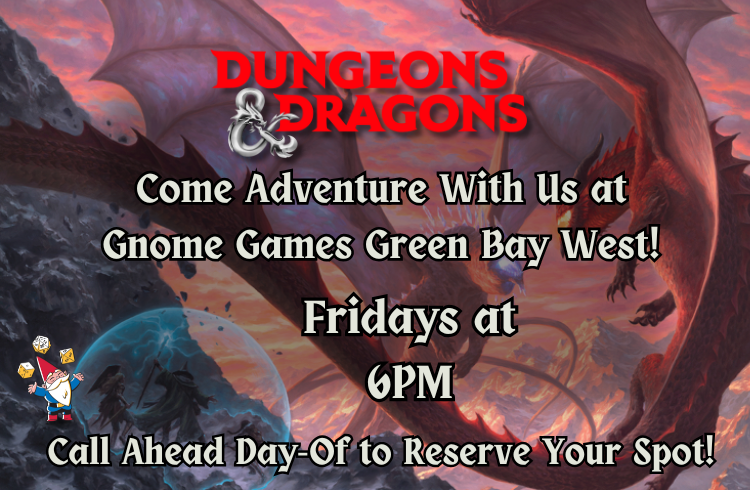
Riftbound Nexus Nights – Fridays at Green Bay West

Join the Gnomes each Friday at 6:30pm for Riftbound’s Nexus Nights!

We’re inviting players out to play Riftbound in a variety of formats with a simple cost of purchasing a pack of Riftbound! Promos will go out based on attendance.

There are a multitude of formats available to play: 1 v 1, 2 v 2, or 3-4 player free for all! You’ll want to stay up to date with the most current errata or rules changes, some of which is available here: https://riftbound.leagueoflegends.com/en-us/news/rules-and-releases/riftbound-origins-card-errata/ 

If you’re looking for help building decks you might like information from the designers: https://riftbound.leagueoflegends.com/en-us/news/rules-and-releases/deckbuilding-primer/

The domains are:

  • Fury (Red) –
    • Fury is about aggression, passion, and the thrill of conquering.
    • Fury decks often use damage-based removal, Accelerate (and other ways to enter ready), and rewards for conquering to achieve victory.
    • Generally, Fury cards have a harder time drawing lots of cards or killing units directly, especially units that stay out of combat in their base.
    • Examples of Fury from popular fiction are Conan the Barbarian, Blade, and Anakin Skywalker.
  • Calm (Green)
    • Calm is about balance, meditation, and the peace of holding.
    • Calm decks often use defensive tricks, moving enemies, and negating interaction (like counterspells and stuns) to defend their holds and achieve victory.
    • Generally, Calm cards have a harder time being very aggressive or interacting without using their units.
    • Examples of Calm from popular fiction are Gandalf, Baloo, and Obi Wan Kenobi.
  • Mind (Blue)
    • Mind is about innovation, outsmarting opponents, and the benefits of intelligence and curiosity.
    • Mind decks often use long-term planning, shrinking tricks, card draw, hidden and gear synergy to gain an advantage and achieve victory.
    • Generally, Mind cards have a harder time with moving units or having efficient units.
    • Examples of Mind from popular fiction are Sherlock Holmes, Curious George, and Yoda.
  • Body (Orange)
    • Body is about physical superiority, agility, and connection to the wilds.
    • Body decks often ramp their resources, play efficient and high impact units, and dominate combats to achieve victory.
    • Generally, Body cards have a harder time with finding efficient card draw or noncombat spells.
    • Examples of Body from popular fiction are The Terminator, Juggernaut, and Chewbacca.
  • Chaos (Purple) –
    • Chaos is about unpredictability, rebellion, and trickiness.
    • Chaos decks often manipulate position and the trash, use hidden tricks, and filter toward the right cards to achieve victory.
    • Generally, Chaos cards have a harder time permanently eliminating a threat or giving permanent advantages to its units.
    • Examples of Chaos from popular fiction are V (for Vendetta), Spiderman, and Han Solo.
  • Order (Yellow) –
    • Order is about unity, community, and sacrifice for the greater good.
    • Order decks often generate many small units, gain effects on unit death, and kill units directly to achieve victory.
    • Generally, Order cards have a harder time dealing with smaller units and moving units.
    • Examples of Order from popular fiction are Superman, Cobra Commander, and Leia Organa.

One way to start building a deck is to start with a domain you think fits your playstyle (or just style, generally) and search for cool cards you might want to fit into a deck.

Look for this and other events at our website: gnomegames.com/events/month!

Riftbound Nexus Nights – Fridays at Green Bay West

Join the Gnomes each Friday at 6:30pm for Riftbound’s Nexus Nights!

We’re inviting players out to play Riftbound in a variety of formats with a simple cost of purchasing a pack of Riftbound! Promos will go out based on attendance.

There are a multitude of formats available to play: 1 v 1, 2 v 2, or 3-4 player free for all! You’ll want to stay up to date with the most current errata or rules changes, some of which is available here: https://riftbound.leagueoflegends.com/en-us/news/rules-and-releases/riftbound-origins-card-errata/ 

If you’re looking for help building decks you might like information from the designers: https://riftbound.leagueoflegends.com/en-us/news/rules-and-releases/deckbuilding-primer/

The domains are:

  • Fury (Red) –
    • Fury is about aggression, passion, and the thrill of conquering.
    • Fury decks often use damage-based removal, Accelerate (and other ways to enter ready), and rewards for conquering to achieve victory.
    • Generally, Fury cards have a harder time drawing lots of cards or killing units directly, especially units that stay out of combat in their base.
    • Examples of Fury from popular fiction are Conan the Barbarian, Blade, and Anakin Skywalker.
  • Calm (Green)
    • Calm is about balance, meditation, and the peace of holding.
    • Calm decks often use defensive tricks, moving enemies, and negating interaction (like counterspells and stuns) to defend their holds and achieve victory.
    • Generally, Calm cards have a harder time being very aggressive or interacting without using their units.
    • Examples of Calm from popular fiction are Gandalf, Baloo, and Obi Wan Kenobi.
  • Mind (Blue)
    • Mind is about innovation, outsmarting opponents, and the benefits of intelligence and curiosity.
    • Mind decks often use long-term planning, shrinking tricks, card draw, hidden and gear synergy to gain an advantage and achieve victory.
    • Generally, Mind cards have a harder time with moving units or having efficient units.
    • Examples of Mind from popular fiction are Sherlock Holmes, Curious George, and Yoda.
  • Body (Orange)
    • Body is about physical superiority, agility, and connection to the wilds.
    • Body decks often ramp their resources, play efficient and high impact units, and dominate combats to achieve victory.
    • Generally, Body cards have a harder time with finding efficient card draw or noncombat spells.
    • Examples of Body from popular fiction are The Terminator, Juggernaut, and Chewbacca.
  • Chaos (Purple) –
    • Chaos is about unpredictability, rebellion, and trickiness.
    • Chaos decks often manipulate position and the trash, use hidden tricks, and filter toward the right cards to achieve victory.
    • Generally, Chaos cards have a harder time permanently eliminating a threat or giving permanent advantages to its units.
    • Examples of Chaos from popular fiction are V (for Vendetta), Spiderman, and Han Solo.
  • Order (Yellow) –
    • Order is about unity, community, and sacrifice for the greater good.
    • Order decks often generate many small units, gain effects on unit death, and kill units directly to achieve victory.
    • Generally, Order cards have a harder time dealing with smaller units and moving units.
    • Examples of Order from popular fiction are Superman, Cobra Commander, and Leia Organa.

One way to start building a deck is to start with a domain you think fits your playstyle (or just style, generally) and search for cool cards you might want to fit into a deck.

Look for this and other events at our website: gnomegames.com/events/month!

Riftbound Nexus Nights – Fridays at Green Bay West

Join the Gnomes each Friday at 6:30pm for Riftbound’s Nexus Nights!

We’re inviting players out to play Riftbound in a variety of formats with a simple cost of purchasing a pack of Riftbound! Promos will go out based on attendance.

There are a multitude of formats available to play: 1 v 1, 2 v 2, or 3-4 player free for all! You’ll want to stay up to date with the most current errata or rules changes, some of which is available here: https://riftbound.leagueoflegends.com/en-us/news/rules-and-releases/riftbound-origins-card-errata/ 

If you’re looking for help building decks you might like information from the designers: https://riftbound.leagueoflegends.com/en-us/news/rules-and-releases/deckbuilding-primer/

The domains are:

  • Fury (Red) –
    • Fury is about aggression, passion, and the thrill of conquering.
    • Fury decks often use damage-based removal, Accelerate (and other ways to enter ready), and rewards for conquering to achieve victory.
    • Generally, Fury cards have a harder time drawing lots of cards or killing units directly, especially units that stay out of combat in their base.
    • Examples of Fury from popular fiction are Conan the Barbarian, Blade, and Anakin Skywalker.
  • Calm (Green)
    • Calm is about balance, meditation, and the peace of holding.
    • Calm decks often use defensive tricks, moving enemies, and negating interaction (like counterspells and stuns) to defend their holds and achieve victory.
    • Generally, Calm cards have a harder time being very aggressive or interacting without using their units.
    • Examples of Calm from popular fiction are Gandalf, Baloo, and Obi Wan Kenobi.
  • Mind (Blue)
    • Mind is about innovation, outsmarting opponents, and the benefits of intelligence and curiosity.
    • Mind decks often use long-term planning, shrinking tricks, card draw, hidden and gear synergy to gain an advantage and achieve victory.
    • Generally, Mind cards have a harder time with moving units or having efficient units.
    • Examples of Mind from popular fiction are Sherlock Holmes, Curious George, and Yoda.
  • Body (Orange)
    • Body is about physical superiority, agility, and connection to the wilds.
    • Body decks often ramp their resources, play efficient and high impact units, and dominate combats to achieve victory.
    • Generally, Body cards have a harder time with finding efficient card draw or noncombat spells.
    • Examples of Body from popular fiction are The Terminator, Juggernaut, and Chewbacca.
  • Chaos (Purple) –
    • Chaos is about unpredictability, rebellion, and trickiness.
    • Chaos decks often manipulate position and the trash, use hidden tricks, and filter toward the right cards to achieve victory.
    • Generally, Chaos cards have a harder time permanently eliminating a threat or giving permanent advantages to its units.
    • Examples of Chaos from popular fiction are V (for Vendetta), Spiderman, and Han Solo.
  • Order (Yellow) –
    • Order is about unity, community, and sacrifice for the greater good.
    • Order decks often generate many small units, gain effects on unit death, and kill units directly to achieve victory.
    • Generally, Order cards have a harder time dealing with smaller units and moving units.
    • Examples of Order from popular fiction are Superman, Cobra Commander, and Leia Organa.

One way to start building a deck is to start with a domain you think fits your playstyle (or just style, generally) and search for cool cards you might want to fit into a deck.

Look for this and other events at our website: gnomegames.com/events/month!