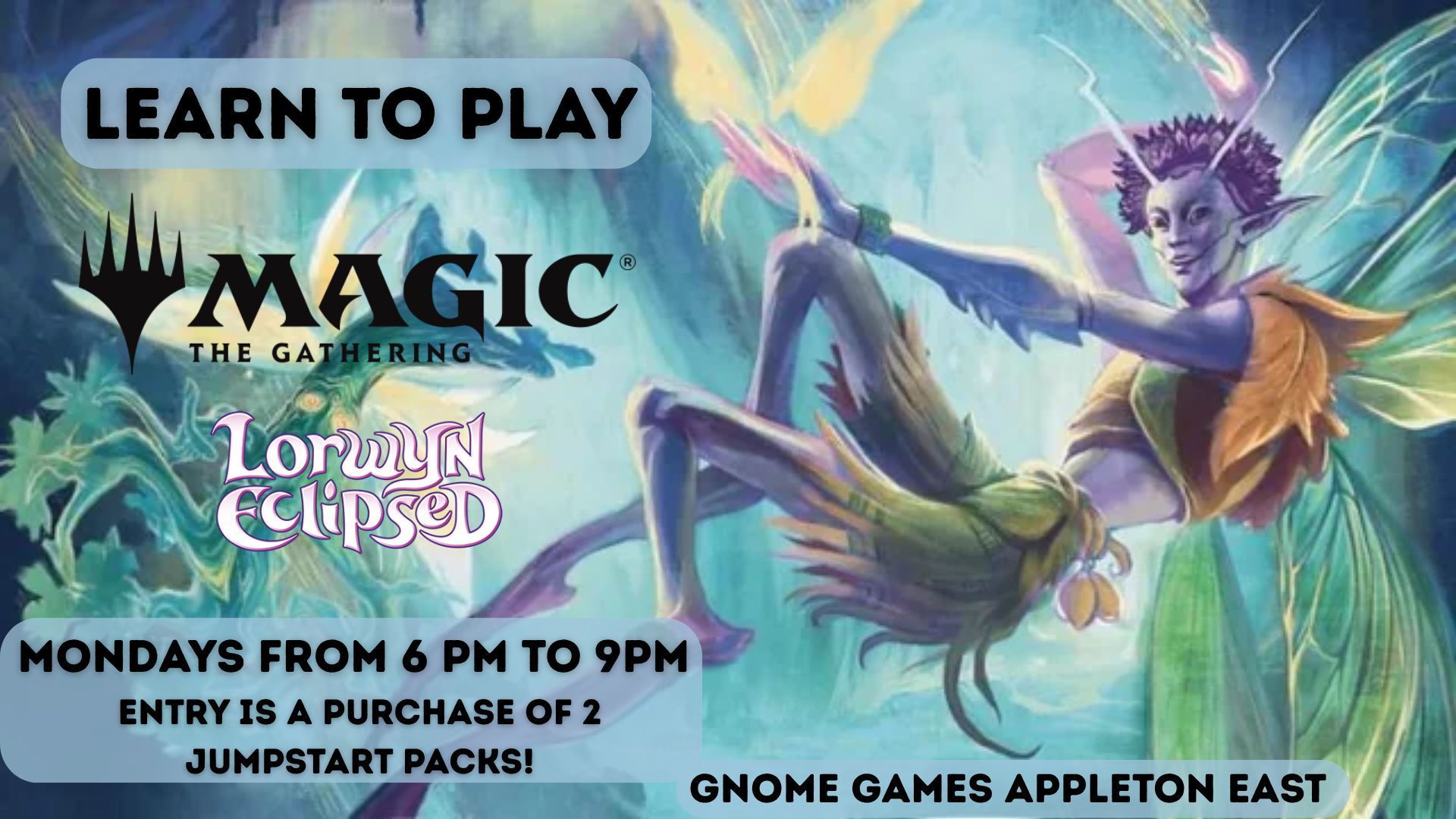
Join us at Gnome Games Appleton East for our Learn to Play Magic the Gathering event!
 Don’t know how to play Magic the Gathering? You’re in the right place! From 6 to 9 PM, stop in and purchase two Jumpstart Boosters to shuffle into a deck, and one of our very own staff members will teach you! Just for participating, you receive a special Welcome Deck. These decks are designed with newer players in mind and emphasize easy to read and understand mechanics.
Our entry for this event is the purchase of two Jumpstart Booster Packs! Otherwise, no experience needed. This event aims solely to teaching you how to play Magic the Gathering!
What is Magic the Gathering?
Magic is a collectible trading card game of fun-filled, strategic games to play with friends old and new. Welcoming worldbuilders, narrative lovers, and gameplay enthusiasts alike, Magic has something for everyone and countless ways to play. Each of the five colors in Magic represent a different philosophy and a different playstyle. Choose your color(s) to decide which type of land you’ll be drawing resources (mana) from and what type of Magic you’ll wield. Magic has thousands of cards so you can always find a way to express yourself on the battlefield! Looking to learn more? Check out the Learn to Play section of their website!
For more news and events from Magic the Gathering, check out their website!
More Magic the Gathering at Gnome Games is on our calendar!
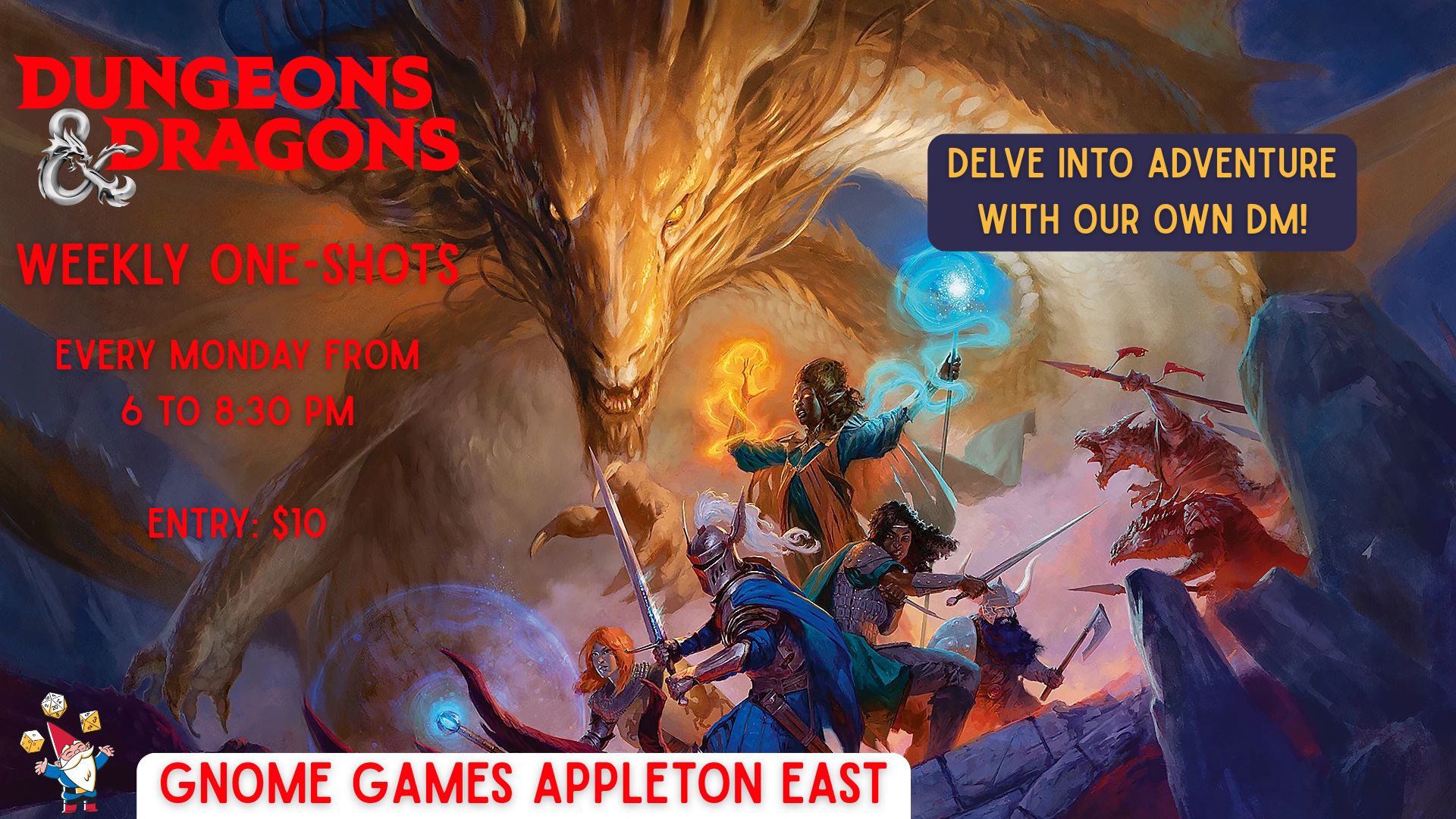
Join us at Gnome Games Appleton East for our Dungeons & Dragons Weekly One-shots!
Every Monday from 6 PM to 8:30 PM, we are hosting Dungeons & Dragons one-shot sessions! Whether you’re newer to the role-playing scene or a veteran just looking for some fun, all are welcome at our tables! Our own Dungeon Master (DM) will guide you through a mini session of daring adventure and fun role-playing for a night to remember!
What do I need to bring?
A full set of dice is required to play. To be more specific, a full set of dice includes a d4 (4-sided die), d6 (6-sided die), d8 (8-sided die), d10 (10-sided die), percentile d10 (00-90), d12 (12-sided die), and d20 (20-sided die). We provide pre-made character sheets! Entry is $10.
What is Dungeons & Dragons?
Dungeons & Dragons is a classic tabletop role-playing game that has been around since 1974! Throughout the years it has developed and grown into a beloved franchise of not just rulebooks, but novels, video games, and even popular movies! In Dungeons & Dragons, players will take on the role of their very own character and act out all of their movements and conversations themselves. Often times these actions will lead into checks the player has to make, where they will roll dice and add some character statistics together to see how well they do! Both success and failure come together to make these games happen, so be ready for anything!
An important part to playing Dungeons & Dragons is having a story teller, lovingly labeled as the Dungeon Master (DM)! The DM will run the campaign for players and dictate how the story flows as the characters progress. They can use preconstructed campaigns referred to as modules, or craft their very own stories from scratch! Either way, the DM usually has a lot of planning to do to make things flow well. It’s a very rewarding feeling, though!
More information is available on D&D Beyond, which highlights both digital and physical aspects of Dungeons & Dragons.
Looking for more Role-playing games at Gnome Games? Check out our calendar!
Join us at Gnome Games Appleton East for our Dungeons & Dragons Weekly One-shots!
Every Monday from 6 PM to 8:30 PM, we are hosting Dungeons & Dragons one-shot sessions! Whether you’re newer to the role-playing scene or a veteran just looking for some fun, all are welcome at our tables! Our own Dungeon Master (DM) will guide you through a mini session of daring adventure and fun role-playing for a night to remember!
What do I need to bring?
A full set of dice is required to play. To be more specific, a full set of dice includes a d4 (4-sided die), d6 (6-sided die), d8 (8-sided die), d10 (10-sided die), percentile d10 (00-90), d12 (12-sided die), and d20 (20-sided die). We provide pre-made character sheets! Entry is $10.
What is Dungeons & Dragons?
Dungeons & Dragons is a classic tabletop role-playing game that has been around since 1974! Throughout the years it has developed and grown into a beloved franchise of not just rulebooks, but novels, video games, and even popular movies! In Dungeons & Dragons, players will take on the role of their very own character and act out all of their movements and conversations themselves. Often times these actions will lead into checks the player has to make, where they will roll dice and add some character statistics together to see how well they do! Both success and failure come together to make these games happen, so be ready for anything!
An important part to playing Dungeons & Dragons is having a story teller, lovingly labeled as the Dungeon Master (DM)! The DM will run the campaign for players and dictate how the story flows as the characters progress. They can use preconstructed campaigns referred to as modules, or craft their very own stories from scratch! Either way, the DM usually has a lot of planning to do to make things flow well. It’s a very rewarding feeling, though!
More information is available on D&D Beyond, which highlights both digital and physical aspects of Dungeons & Dragons.
Looking for more Role-playing games at Gnome Games? Check out our calendar!
Join us at Gnome Games Appleton East for our Dungeons & Dragons Weekly One-shots!
Every Monday from 6 PM to 8:30 PM, we are hosting Dungeons & Dragons one-shot sessions! Whether you’re newer to the role-playing scene or a veteran just looking for some fun, all are welcome at our tables! Our own Dungeon Master (DM) will guide you through a mini session of daring adventure and fun role-playing for a night to remember!
What do I need to bring?
A full set of dice is required to play. To be more specific, a full set of dice includes a d4 (4-sided die), d6 (6-sided die), d8 (8-sided die), d10 (10-sided die), percentile d10 (00-90), d12 (12-sided die), and d20 (20-sided die). We provide pre-made character sheets! Entry is $10.
What is Dungeons & Dragons?
Dungeons & Dragons is a classic tabletop role-playing game that has been around since 1974! Throughout the years it has developed and grown into a beloved franchise of not just rulebooks, but novels, video games, and even popular movies! In Dungeons & Dragons, players will take on the role of their very own character and act out all of their movements and conversations themselves. Often times these actions will lead into checks the player has to make, where they will roll dice and add some character statistics together to see how well they do! Both success and failure come together to make these games happen, so be ready for anything!
An important part to playing Dungeons & Dragons is having a story teller, lovingly labeled as the Dungeon Master (DM)! The DM will run the campaign for players and dictate how the story flows as the characters progress. They can use preconstructed campaigns referred to as modules, or craft their very own stories from scratch! Either way, the DM usually has a lot of planning to do to make things flow well. It’s a very rewarding feeling, though!
More information is available on D&D Beyond, which highlights both digital and physical aspects of Dungeons & Dragons.
Looking for more Role-playing games at Gnome Games? Check out our calendar!
Join us at Gnome Games Appleton East for our Dungeons & Dragons Weekly One-shots!
Every Monday from 6 PM to 8:30 PM, we are hosting Dungeons & Dragons one-shot sessions! Whether you’re newer to the role-playing scene or a veteran just looking for some fun, all are welcome at our tables! Our own Dungeon Master (DM) will guide you through a mini session of daring adventure and fun role-playing for a night to remember!
What do I need to bring?
A full set of dice is required to play. To be more specific, a full set of dice includes a d4 (4-sided die), d6 (6-sided die), d8 (8-sided die), d10 (10-sided die), percentile d10 (00-90), d12 (12-sided die), and d20 (20-sided die). We provide pre-made character sheets! Entry is $10.
What is Dungeons & Dragons?
Dungeons & Dragons is a classic tabletop role-playing game that has been around since 1974! Throughout the years it has developed and grown into a beloved franchise of not just rulebooks, but novels, video games, and even popular movies! In Dungeons & Dragons, players will take on the role of their very own character and act out all of their movements and conversations themselves. Often times these actions will lead into checks the player has to make, where they will roll dice and add some character statistics together to see how well they do! Both success and failure come together to make these games happen, so be ready for anything!
An important part to playing Dungeons & Dragons is having a story teller, lovingly labeled as the Dungeon Master (DM)! The DM will run the campaign for players and dictate how the story flows as the characters progress. They can use preconstructed campaigns referred to as modules, or craft their very own stories from scratch! Either way, the DM usually has a lot of planning to do to make things flow well. It’s a very rewarding feeling, though!
More information is available on D&D Beyond, which highlights both digital and physical aspects of Dungeons & Dragons.
Looking for more Role-playing games at Gnome Games? Check out our calendar!
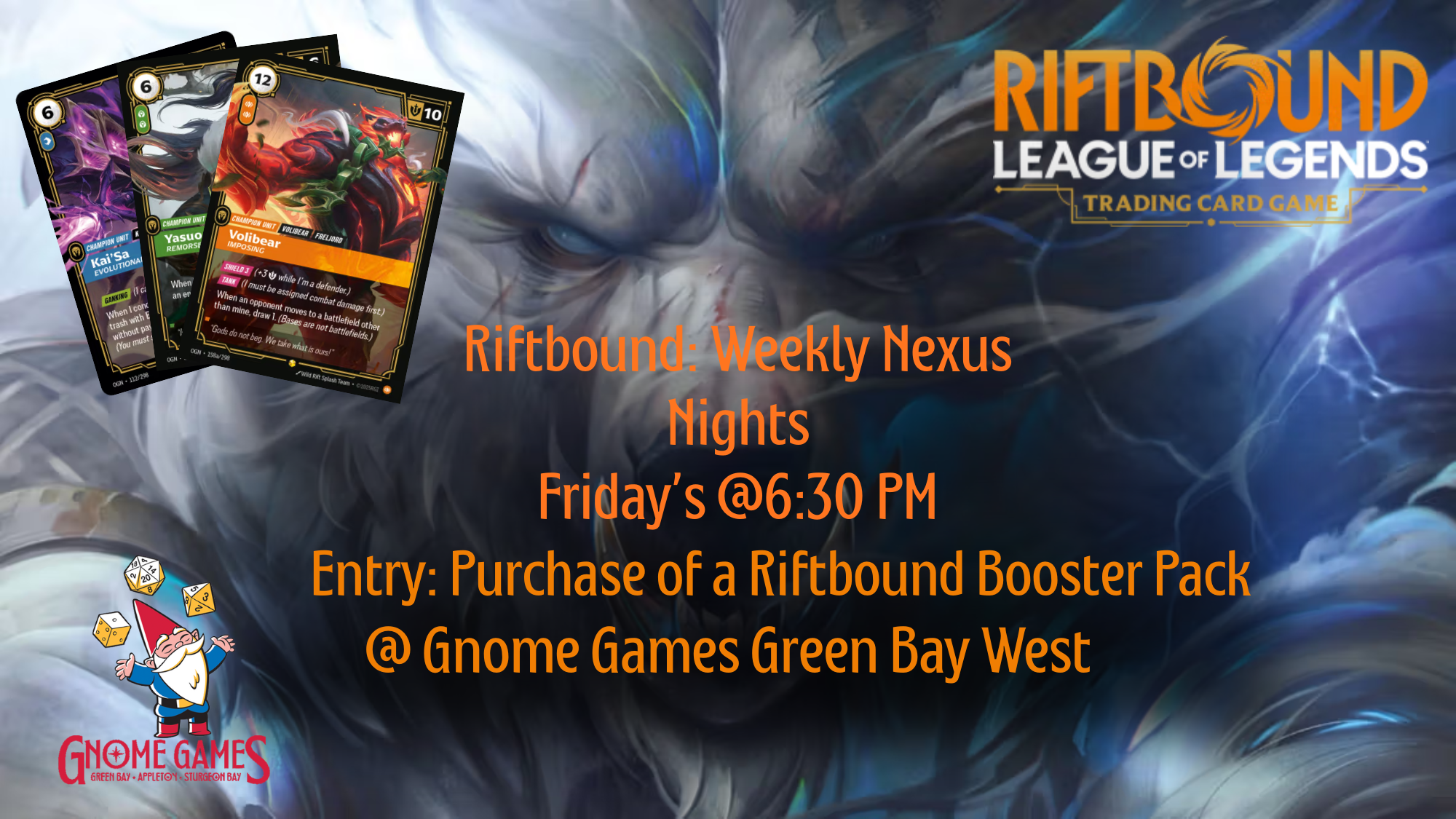
Join the Gnomes each Friday at 6:30pm for Riftbound’s Nexus Nights!
We’re inviting players out to play Riftbound in a variety of formats with a simple cost of purchasing a pack of Riftbound! Promos will go out based on attendance.
There are a multitude of formats available to play: 1 v 1, 2 v 2, or 3-4 player free for all! You’ll want to stay up to date with the most current errata or rules changes, some of which is available here: https://riftbound.leagueoflegends.com/en-us/news/rules-and-releases/riftbound-origins-card-errata/
If you’re looking for help building decks you might like information from the designers: https://riftbound.leagueoflegends.com/en-us/news/rules-and-releases/deckbuilding-primer/
The domains are:
- Fury (Red) –
- Fury is about aggression, passion, and the thrill of conquering.
- Fury decks often use damage-based removal, Accelerate (and other ways to enter ready), and rewards for conquering to achieve victory.
- Generally, Fury cards have a harder time drawing lots of cards or killing units directly, especially units that stay out of combat in their base.
- Examples of Fury from popular fiction are Conan the Barbarian, Blade, and Anakin Skywalker.
- Calm (Green) –
- Calm is about balance, meditation, and the peace of holding.
- Calm decks often use defensive tricks, moving enemies, and negating interaction (like counterspells and stuns) to defend their holds and achieve victory.
- Generally, Calm cards have a harder time being very aggressive or interacting without using their units.
- Examples of Calm from popular fiction are Gandalf, Baloo, and Obi Wan Kenobi.
- Mind (Blue) –
- Mind is about innovation, outsmarting opponents, and the benefits of intelligence and curiosity.
- Mind decks often use long-term planning, shrinking tricks, card draw, hidden and gear synergy to gain an advantage and achieve victory.
- Generally, Mind cards have a harder time with moving units or having efficient units.
- Examples of Mind from popular fiction are Sherlock Holmes, Curious George, and Yoda.
- Body (Orange) –
- Body is about physical superiority, agility, and connection to the wilds.
- Body decks often ramp their resources, play efficient and high impact units, and dominate combats to achieve victory.
- Generally, Body cards have a harder time with finding efficient card draw or noncombat spells.
- Examples of Body from popular fiction are The Terminator, Juggernaut, and Chewbacca.
- Chaos (Purple) –
- Chaos is about unpredictability, rebellion, and trickiness.
- Chaos decks often manipulate position and the trash, use hidden tricks, and filter toward the right cards to achieve victory.
- Generally, Chaos cards have a harder time permanently eliminating a threat or giving permanent advantages to its units.
- Examples of Chaos from popular fiction are V (for Vendetta), Spiderman, and Han Solo.
- Order (Yellow) –
- Order is about unity, community, and sacrifice for the greater good.
- Order decks often generate many small units, gain effects on unit death, and kill units directly to achieve victory.
- Generally, Order cards have a harder time dealing with smaller units and moving units.
- Examples of Order from popular fiction are Superman, Cobra Commander, and Leia Organa.
One way to start building a deck is to start with a domain you think fits your playstyle (or just style, generally) and search for cool cards you might want to fit into a deck.
Look for this and other events at our website: gnomegames.com/events/month!
Join the Gnomes each Friday at 6:30pm for Riftbound’s Nexus Nights!
We’re inviting players out to play Riftbound in a variety of formats with a simple cost of purchasing a pack of Riftbound! Promos will go out based on attendance.
There are a multitude of formats available to play: 1 v 1, 2 v 2, or 3-4 player free for all! You’ll want to stay up to date with the most current errata or rules changes, some of which is available here: https://riftbound.leagueoflegends.com/en-us/news/rules-and-releases/riftbound-origins-card-errata/
If you’re looking for help building decks you might like information from the designers: https://riftbound.leagueoflegends.com/en-us/news/rules-and-releases/deckbuilding-primer/
The domains are:
- Fury (Red) –
- Fury is about aggression, passion, and the thrill of conquering.
- Fury decks often use damage-based removal, Accelerate (and other ways to enter ready), and rewards for conquering to achieve victory.
- Generally, Fury cards have a harder time drawing lots of cards or killing units directly, especially units that stay out of combat in their base.
- Examples of Fury from popular fiction are Conan the Barbarian, Blade, and Anakin Skywalker.
- Calm (Green) –
- Calm is about balance, meditation, and the peace of holding.
- Calm decks often use defensive tricks, moving enemies, and negating interaction (like counterspells and stuns) to defend their holds and achieve victory.
- Generally, Calm cards have a harder time being very aggressive or interacting without using their units.
- Examples of Calm from popular fiction are Gandalf, Baloo, and Obi Wan Kenobi.
- Mind (Blue) –
- Mind is about innovation, outsmarting opponents, and the benefits of intelligence and curiosity.
- Mind decks often use long-term planning, shrinking tricks, card draw, hidden and gear synergy to gain an advantage and achieve victory.
- Generally, Mind cards have a harder time with moving units or having efficient units.
- Examples of Mind from popular fiction are Sherlock Holmes, Curious George, and Yoda.
- Body (Orange) –
- Body is about physical superiority, agility, and connection to the wilds.
- Body decks often ramp their resources, play efficient and high impact units, and dominate combats to achieve victory.
- Generally, Body cards have a harder time with finding efficient card draw or noncombat spells.
- Examples of Body from popular fiction are The Terminator, Juggernaut, and Chewbacca.
- Chaos (Purple) –
- Chaos is about unpredictability, rebellion, and trickiness.
- Chaos decks often manipulate position and the trash, use hidden tricks, and filter toward the right cards to achieve victory.
- Generally, Chaos cards have a harder time permanently eliminating a threat or giving permanent advantages to its units.
- Examples of Chaos from popular fiction are V (for Vendetta), Spiderman, and Han Solo.
- Order (Yellow) –
- Order is about unity, community, and sacrifice for the greater good.
- Order decks often generate many small units, gain effects on unit death, and kill units directly to achieve victory.
- Generally, Order cards have a harder time dealing with smaller units and moving units.
- Examples of Order from popular fiction are Superman, Cobra Commander, and Leia Organa.
One way to start building a deck is to start with a domain you think fits your playstyle (or just style, generally) and search for cool cards you might want to fit into a deck.
Look for this and other events at our website: gnomegames.com/events/month!
Join the Gnomes each Friday at 6:30pm for Riftbound’s Nexus Nights!
We’re inviting players out to play Riftbound in a variety of formats with a simple cost of purchasing a pack of Riftbound! Promos will go out based on attendance.
There are a multitude of formats available to play: 1 v 1, 2 v 2, or 3-4 player free for all! You’ll want to stay up to date with the most current errata or rules changes, some of which is available here: https://riftbound.leagueoflegends.com/en-us/news/rules-and-releases/riftbound-origins-card-errata/
If you’re looking for help building decks you might like information from the designers: https://riftbound.leagueoflegends.com/en-us/news/rules-and-releases/deckbuilding-primer/
The domains are:
- Fury (Red) –
- Fury is about aggression, passion, and the thrill of conquering.
- Fury decks often use damage-based removal, Accelerate (and other ways to enter ready), and rewards for conquering to achieve victory.
- Generally, Fury cards have a harder time drawing lots of cards or killing units directly, especially units that stay out of combat in their base.
- Examples of Fury from popular fiction are Conan the Barbarian, Blade, and Anakin Skywalker.
- Calm (Green) –
- Calm is about balance, meditation, and the peace of holding.
- Calm decks often use defensive tricks, moving enemies, and negating interaction (like counterspells and stuns) to defend their holds and achieve victory.
- Generally, Calm cards have a harder time being very aggressive or interacting without using their units.
- Examples of Calm from popular fiction are Gandalf, Baloo, and Obi Wan Kenobi.
- Mind (Blue) –
- Mind is about innovation, outsmarting opponents, and the benefits of intelligence and curiosity.
- Mind decks often use long-term planning, shrinking tricks, card draw, hidden and gear synergy to gain an advantage and achieve victory.
- Generally, Mind cards have a harder time with moving units or having efficient units.
- Examples of Mind from popular fiction are Sherlock Holmes, Curious George, and Yoda.
- Body (Orange) –
- Body is about physical superiority, agility, and connection to the wilds.
- Body decks often ramp their resources, play efficient and high impact units, and dominate combats to achieve victory.
- Generally, Body cards have a harder time with finding efficient card draw or noncombat spells.
- Examples of Body from popular fiction are The Terminator, Juggernaut, and Chewbacca.
- Chaos (Purple) –
- Chaos is about unpredictability, rebellion, and trickiness.
- Chaos decks often manipulate position and the trash, use hidden tricks, and filter toward the right cards to achieve victory.
- Generally, Chaos cards have a harder time permanently eliminating a threat or giving permanent advantages to its units.
- Examples of Chaos from popular fiction are V (for Vendetta), Spiderman, and Han Solo.
- Order (Yellow) –
- Order is about unity, community, and sacrifice for the greater good.
- Order decks often generate many small units, gain effects on unit death, and kill units directly to achieve victory.
- Generally, Order cards have a harder time dealing with smaller units and moving units.
- Examples of Order from popular fiction are Superman, Cobra Commander, and Leia Organa.
One way to start building a deck is to start with a domain you think fits your playstyle (or just style, generally) and search for cool cards you might want to fit into a deck.
Look for this and other events at our website: gnomegames.com/events/month!
Join the Gnomes each Friday at 6:30pm for Riftbound’s Nexus Nights!
We’re inviting players out to play Riftbound in a variety of formats with a simple cost of purchasing a pack of Riftbound! Promos will go out based on attendance.
There are a multitude of formats available to play: 1 v 1, 2 v 2, or 3-4 player free for all! You’ll want to stay up to date with the most current errata or rules changes, some of which is available here: https://riftbound.leagueoflegends.com/en-us/news/rules-and-releases/riftbound-origins-card-errata/
If you’re looking for help building decks you might like information from the designers: https://riftbound.leagueoflegends.com/en-us/news/rules-and-releases/deckbuilding-primer/
The domains are:
- Fury (Red) –
- Fury is about aggression, passion, and the thrill of conquering.
- Fury decks often use damage-based removal, Accelerate (and other ways to enter ready), and rewards for conquering to achieve victory.
- Generally, Fury cards have a harder time drawing lots of cards or killing units directly, especially units that stay out of combat in their base.
- Examples of Fury from popular fiction are Conan the Barbarian, Blade, and Anakin Skywalker.
- Calm (Green) –
- Calm is about balance, meditation, and the peace of holding.
- Calm decks often use defensive tricks, moving enemies, and negating interaction (like counterspells and stuns) to defend their holds and achieve victory.
- Generally, Calm cards have a harder time being very aggressive or interacting without using their units.
- Examples of Calm from popular fiction are Gandalf, Baloo, and Obi Wan Kenobi.
- Mind (Blue) –
- Mind is about innovation, outsmarting opponents, and the benefits of intelligence and curiosity.
- Mind decks often use long-term planning, shrinking tricks, card draw, hidden and gear synergy to gain an advantage and achieve victory.
- Generally, Mind cards have a harder time with moving units or having efficient units.
- Examples of Mind from popular fiction are Sherlock Holmes, Curious George, and Yoda.
- Body (Orange) –
- Body is about physical superiority, agility, and connection to the wilds.
- Body decks often ramp their resources, play efficient and high impact units, and dominate combats to achieve victory.
- Generally, Body cards have a harder time with finding efficient card draw or noncombat spells.
- Examples of Body from popular fiction are The Terminator, Juggernaut, and Chewbacca.
- Chaos (Purple) –
- Chaos is about unpredictability, rebellion, and trickiness.
- Chaos decks often manipulate position and the trash, use hidden tricks, and filter toward the right cards to achieve victory.
- Generally, Chaos cards have a harder time permanently eliminating a threat or giving permanent advantages to its units.
- Examples of Chaos from popular fiction are V (for Vendetta), Spiderman, and Han Solo.
- Order (Yellow) –
- Order is about unity, community, and sacrifice for the greater good.
- Order decks often generate many small units, gain effects on unit death, and kill units directly to achieve victory.
- Generally, Order cards have a harder time dealing with smaller units and moving units.
- Examples of Order from popular fiction are Superman, Cobra Commander, and Leia Organa.
One way to start building a deck is to start with a domain you think fits your playstyle (or just style, generally) and search for cool cards you might want to fit into a deck.
Look for this and other events at our website: gnomegames.com/events/month!
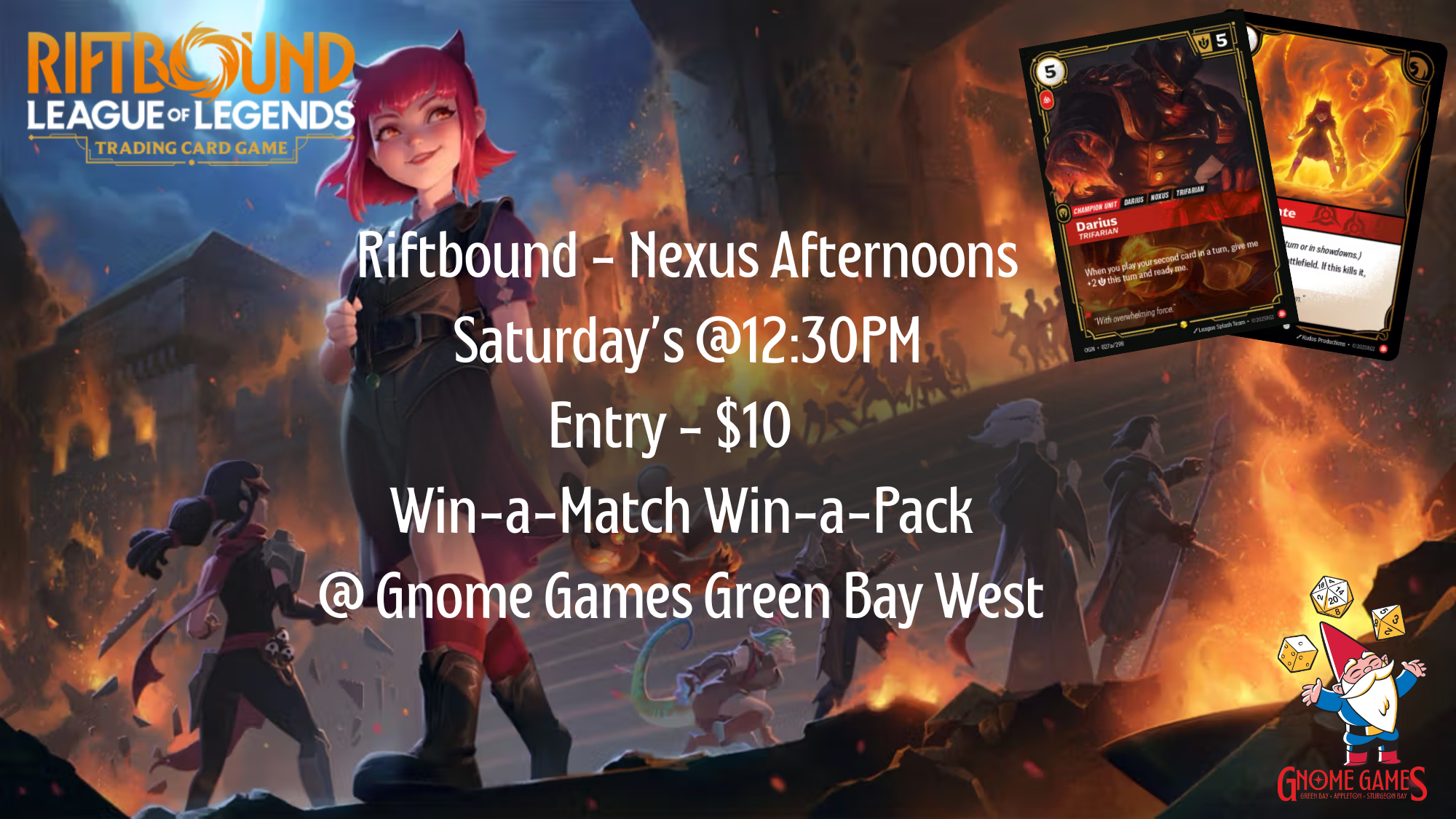
 Join the Gnomes on Saturdays at 12:30pm for a Riftbound Nexus Tournament!
3 rounds of play, with Win-A-Match, Win-A-Pack prizing!
Each match will be best 2 of 3, 50 minute round.
This is a casual Local Constructed tournament with Swiss rounds!
Nexus Night promo packs will be awarded based on availability!
Here are some pertinent tournament rules to follow!
You may have a sideboard, following official rules:
- In constructed format’s, a player’s sideboard must be exactly 0 or 8 cards.
- 403.3. A sideboard can consist only of valid Main Deck cards.
- 403.4. Limits on copies of named cards apply to the combination of Main Deck and sideboard.
- 403.5. Players may use those cards to modify their deck after the first game of a match.
- 403.5.a. During that time, a player may change their Chosen Champion to one from their sideboard or main deck that matches their Legend.
- 403.5.b. A player may not change their Legend or Battlefields at any point after deck registration.
- 403.5.c. A player’s Main Deck must be exactly 40 cards after this process.
- 403.6. Players may not use sideboard cards in the first game of a match.
Match
- 404.1. A match of Riftbound consists of a series of games that are played until one side has won a predetermined number of games.
- 404.2. Most matches of Riftbound are “best of 3,” meaning the predetermined number of games to win is 2.
- 404.3. Games that end in a draw do not count toward this goal.
- 404.4. If the competition round ends (due to time limits) prior to any side achieving the goal, the winner of the match is the one who has won the most games.
- 404.5. If all sides have equal game wins, the match is a draw.
408. End of Match Procedure
- 408.1. A match is complete once a match result is recorded by players or a tournament official.
- 408.2. If the time limit for a competition round is reached before a winner is determined, the player whose turn it is finishes their turn.
- 408.2.a. After that player’s turn is complete, five additional turns are played, and then the match ends.
- 408.2.b. If the game is incomplete at the end of the additional turns, the winner of the game is the one with the highest score. If scores are tied, the game is a draw.
- 408.2.c. Additional turns are untimed, but at high OPL a judge must be present to ensure a reasonable pace of play.
- 408.2.d. If the players are between games when the round time ends, no new game is started.
Links
Fridays you may want to come in and playtest, and Saturdays are for tournaments! Watch for both on our calendar: www.gnomegames.com/events/month
You’ll want to stay up to date with the most current errata or rules changes, some of which is available here: https://riftbound.leagueoflegends.com/en-us/news/rules-and-releases/riftbound-origins-card-errata/
If you’re looking for help building decks you might like information from the designers: https://riftbound.leagueoflegends.com/en-us/news/rules-and-releases/deckbuilding-primer/