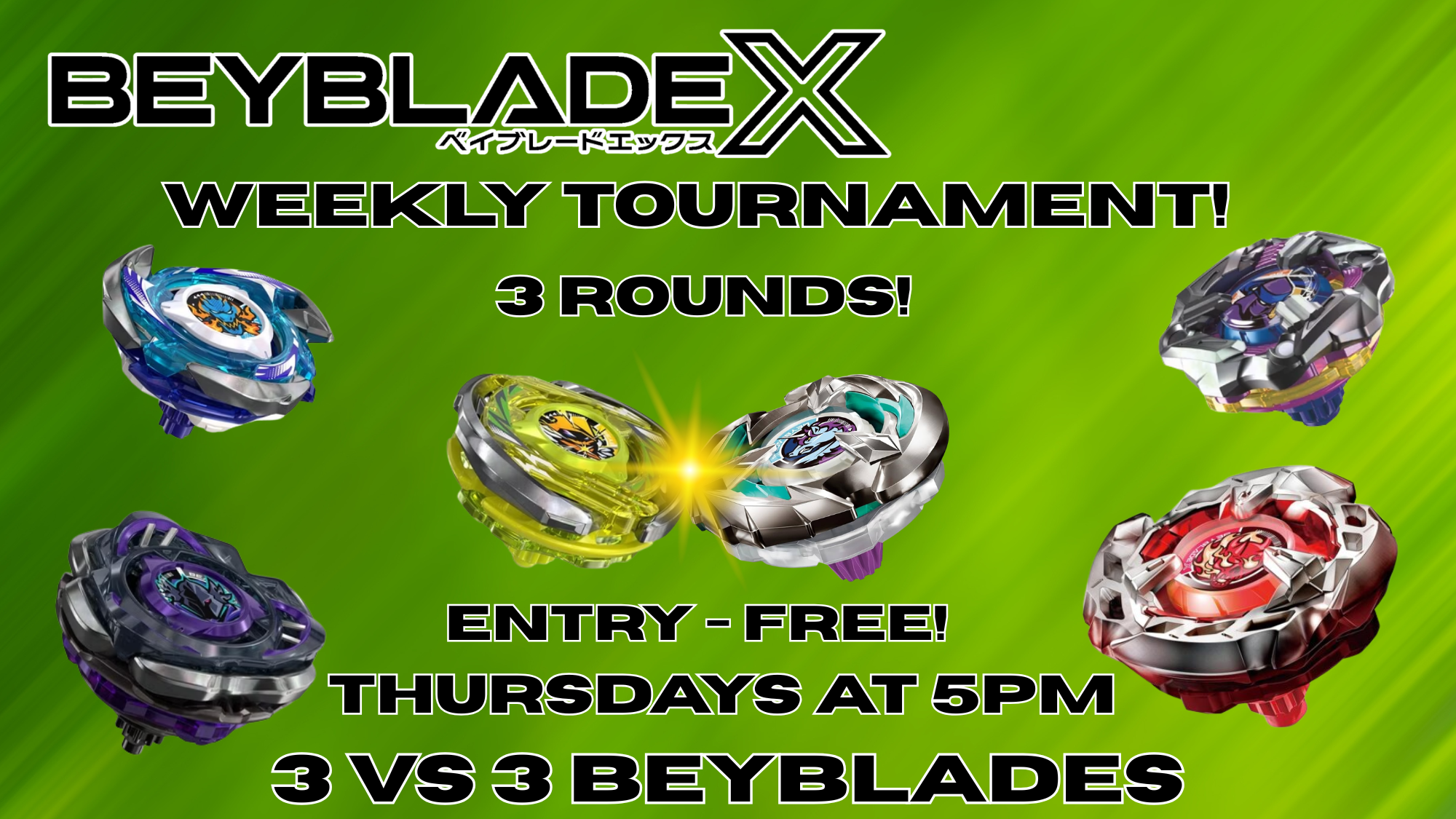
Let it rip at Gnome Games Appleton North for our weekly BeybladeX 3v3 tournament!
Have you ever been curious about how a Beyblade Tournament runs? Join us every Thursday to experience a casual level tournament that introduces players to the basics of tournament structure. This event is intended to let players participate in a tournament and learn the basics of match structure, battle rules, and overall tournament flow. Our rules are based on the rules from https://worldbeyblade.org/Thread-Beyblade-X-Rules but streamlined to make it easier to understand for first time players.
Entry: Free!
Thursdays at 5pm
3 v 3 Tournament, 3 Round tournament
Arena: Green BeybladeX Beystadium
Players bring a deck of 3 Beys (must be BeybladeX)
Match Type:
Earn 4 points to win a set. Win two 4-point sets to win the match.
Match Structure:
- Each blader orders their Beys from left to right as the 1st Bey, 2nd Bey, and 3rd Bey
- For the first battle, each blader uses their 1st Bey. For each battle afterwards, bladers must use the next Bey in their deck order.
- After battling with the 3rd Bey, both bladers may change the order of their deck in secret. Then, each blader uses their 1st Bey for the next battle
Battle:
- Both bladers present the Beys they will use in the battle to each other by showing the top and bottom of the Bey so that all parts are clearly visible
- Attach your Bey to your launcher and hold it within launch range
- directly above or within your half of the arena
- with the Bit of the Bey no higher than 2 inches above the stadiums highest point
- with the Bey not tilted more than 70° in any direction
- Bladers must launch in a way that doesn’t interfere with their opponent. For example: touching the opponent’s launcher or physically touching the opponent in any way.
Launch:
- During the countdown, players will call out: “three, two, one, let it rip!”
- Players launch their Bey when “rip” is called.
Resolve Battle:
- A Bey becomes finished when it stops spinning, bursts, or is unable to return to the battle zone.
- The battle ends as soon as either:
- One Bey is spinning in the battle zone while the opposing Bey is finished, OR
- Both Beys are finished.
- Do not touch any Beys until the battle results have been confirmed by each player or judge
Battle Result:
- When the battle ends, the blader that scored a finish wins the battle, and earns points based on how the opposing Bey was finished.
Scoring:
- Over Finish – 2 Points
- Initiated when the opponent’s Bey enters the overzone.
- Scored when the opponent’s Bey becomes unable to return to the battle zone.
- Burst Finish – 2 Points
- Initiated and scored when the opponent’s Bey bursts while in the battle zone.
- Out of Bounds Finish – 1 Point
- Initiated and scored when the opponent’s Bey leaves the arena.
- Spin Finish – 1 Point
- Initiated and scored when the opponent’s Bey stops spinning while in the battle zone.
Join us for a Riftbound Origins draft night! Players will draft a deck from Riftbound Origins booster packs, then participate in a best of 3, 3-round swiss tournament. Win-a-match, win-a-pack!
June 22 at 5pm
Entry: $25
Player Capacity: 8
Reserve your spot on Carde.io: https://locator.riftbound.uvsgames.com/events/625278
Draft is a limited format where players are each provided with 3 unopened Riftbound booster packs to open and draft amongst other players. Drafts pods run with 4-8 players. Each player will open their first booster pack, pick a card from it, then pass the remaining cards to the player on their left. Once the first pack is completed, open the second pack, pick a card, but this time pass to the player on your right. Repeat the same process with the third pack but pass to the left.
- Main decks for draft must be at least 20 cards but can be more.
- The domain identity of a draft deck is any three domains, or any domain plus the domains of the deck’s Champion Legend.
- A draft deck may have any Champion Unit that is included in its domain identity as its Chosen Champion.
- A draft deck may contain any signature spells that are fully included in its domain identity.
- A player may opt not to use a Champion Legend or a Chosen Champion in their draft deck even if they have them among their drafted cards.
- If a player’s deck is missing a Champion Legend and/or a Chosen Champion, they draw a card at the start of their first Beginning Phase each game.
- The normal restrictions on quantities of cards do not apply. For example, a player may use 10 Pouty Poro in their Main Deck if they selected them during the draft.
- All cards drafted but not in the main deck are considered to be your side board.
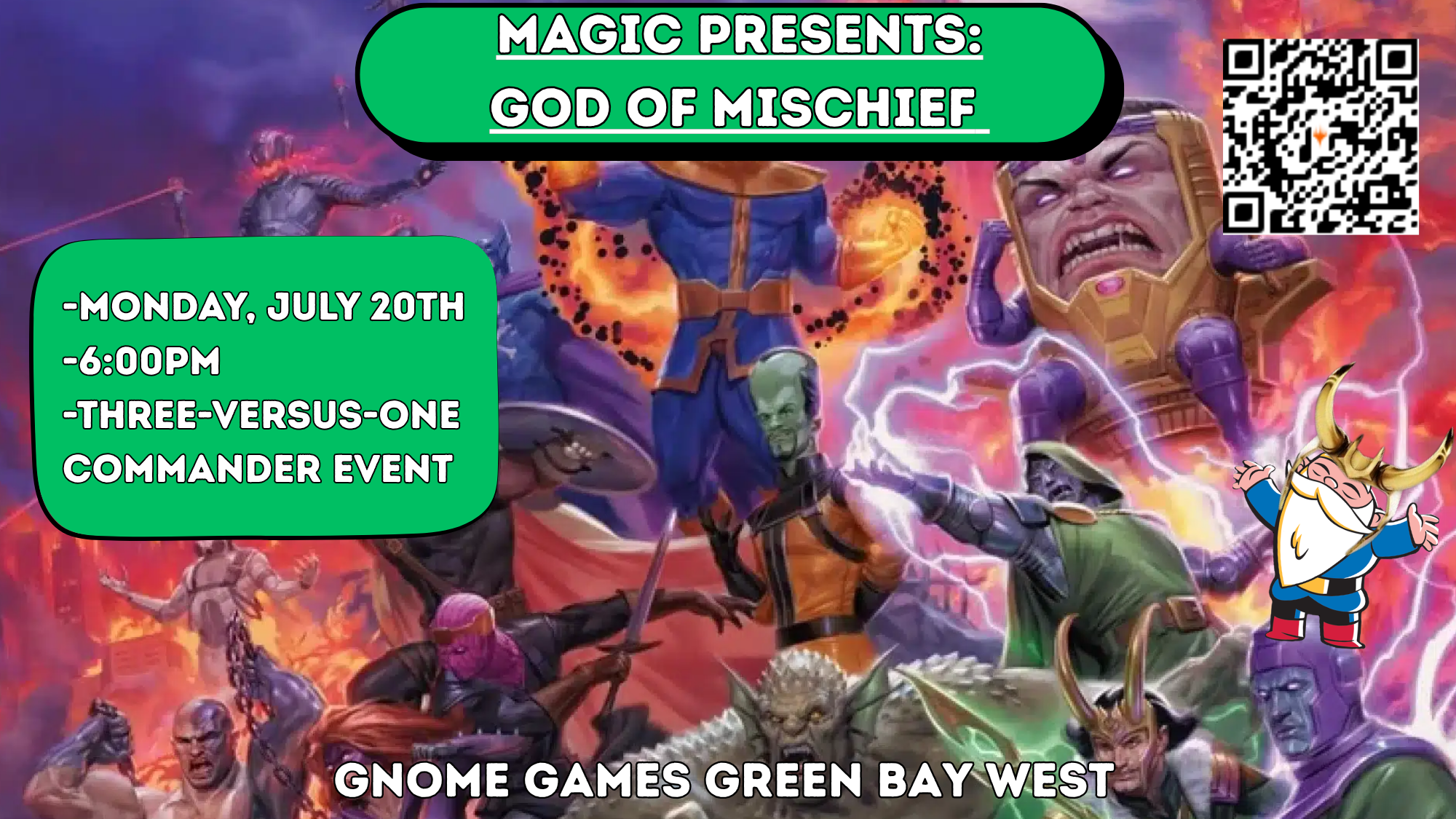
Do you and your squad of Heroes have what it takes to take down Loki in Magic Presents: God of Mischief at Gnome Games Green Bay West!
Fight against the ultimate God of Mischief in this new 3v1 format of Magic the Gathering!
COMPANION APP CODE: DWDG752
Don’t have the Companion App? Download it here!
What Is Magic Presents: God of Mischief?
Magic Presents: God of Mischief is a three-versus-one Commander event. One player assumes the role of Loki, the God of Mischief himself, and has access to a set of advantages called “Loki’s Tricks.” The other three players assemble as the heroes and team up against Loki, braving the significant advantages provided by Loki’s Tricks. The player acting as Loki starts the game with a play aid that lists a selection of “Loki’s Tricks.” The Loki player goes first and starts with 60 life. On each of their turns, the Loki player must select a new Trick from the options available on the play aid. The other three players, the heroes, take their turns simultaneously and have a shared life total of 60.
Want to see what other Magic the Gathering events we have coming up at Gnome Games? Check out our Event Calendar!
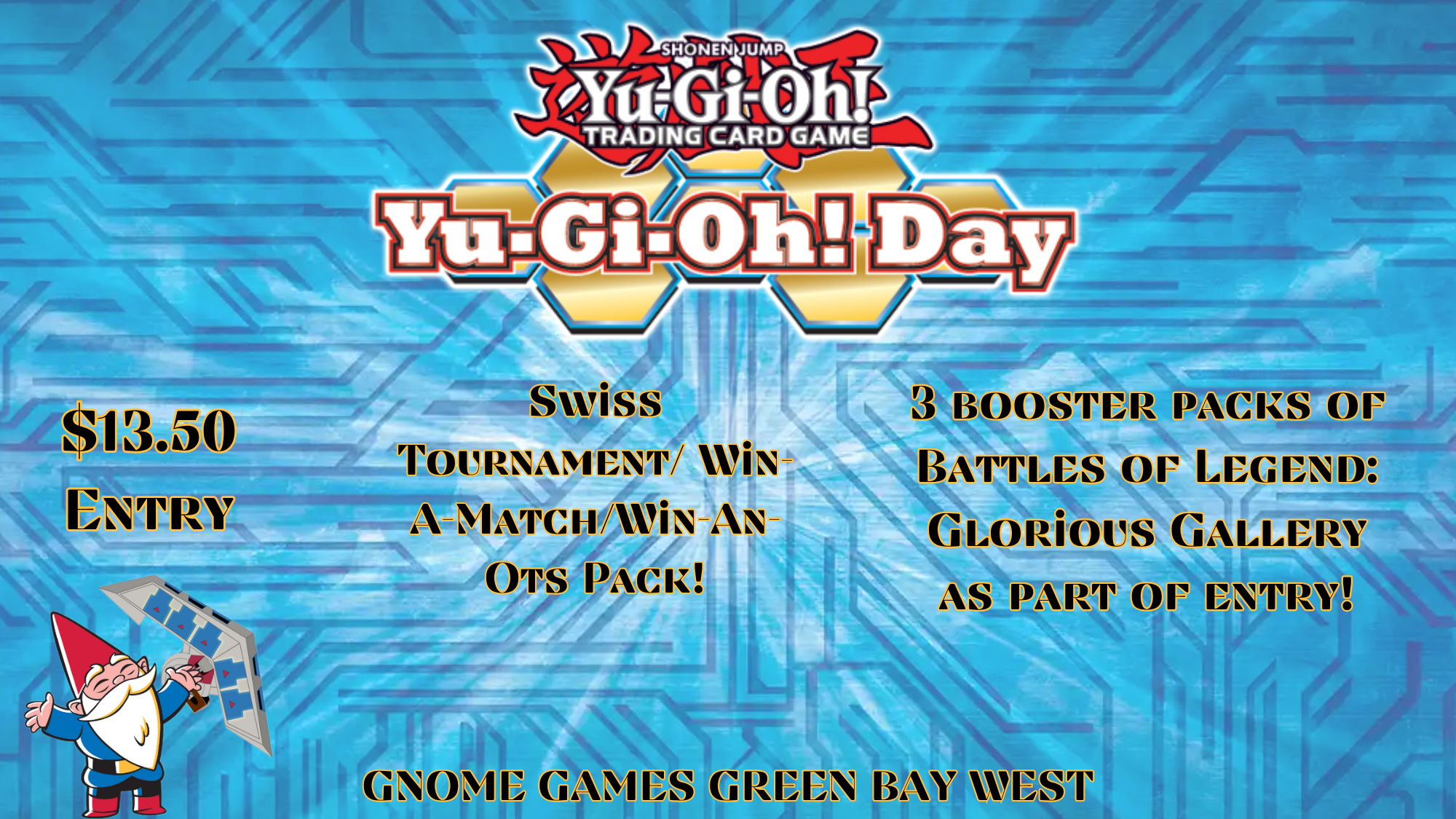
Celebrate YU-GI-OH! Day with us over at Gnome Games Green Bay West!
- Sunday, June 14th
- $13.50 Entry
Players will receive three booster packs of Battles of Legend: Glorious Gallery as part of entry into the event, and play in an Advanced Format, Swiss-Style Tournament (rounds based on attendance), where the Overall Winner will take home an Exclusive Yu-gi-oh! Day 2026 Game Mat! (One Mat will also go out to one lucky attendee of the event as well!)
**All Participants will need a Konami ID registered on the YU-GI-OH! Neuron App, which can be downloaded here!
Prizing:
1st Place: Yu-Gi-Oh! Day 2026 Game Mat
Top 8: Yu-Gi-Oh! Day 2026 Field Center Card

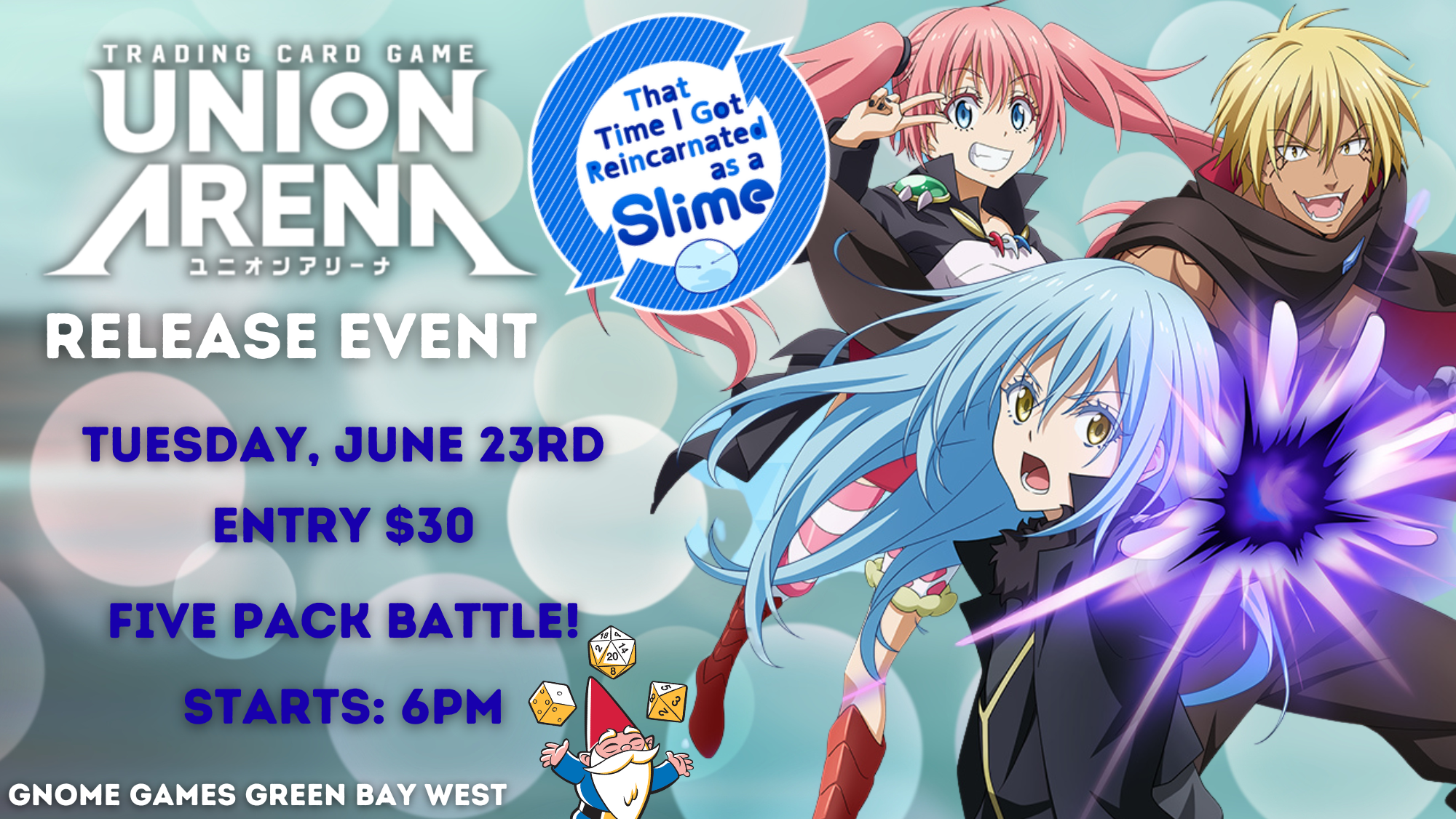
Join us at Gnome Games Green Bay West for our Union Arena: That Time I Got Reincarnated as a Slime (UE20BT) Release Event!
Join in the fun as the hit anime That Time I Got Reincarnated as a Slime joins Union Arena with our That Time I Got Reincarnated as a Slime (UE20BT) Release Event!
- Tuesday, June 23rd
- $30.00 Entry
- 6:00PM
This release event will be a 3 round Swiss-style Tournament. Players will open 5 packs of Slime and use them to build a deck to compete in matches. Each round won awards players with an additional pack! Each participant gets a Release Event Pack and a promotional card. One Winner will get a special Winner foil stamped promotional card!
How does Deckbuilding Work?
Because of how sealed events operate, decks can have more than four cards with the same card number. It can also contain more than four of each of the Special, Color, and Final trigger types. 5 booster packs contribute to creating as close to a 60 card deck as possible. A deck needs 3 Action Point cards, Raids can be performed using cards with two different colors, and five Special triggers can be in a deck. Bring your own sleeves from home or purchase some before the event!
For 5 Pack Battle Rules, Check HERE for more info!
For more information on how to play Union Arena, check here!
Interested in more Union Arena news? Check out their website!
More Union Arena Events can be found on our Gnome Games Event calendar!
*Players will need to register for the event on the Bandai TCG+, which can be found here!
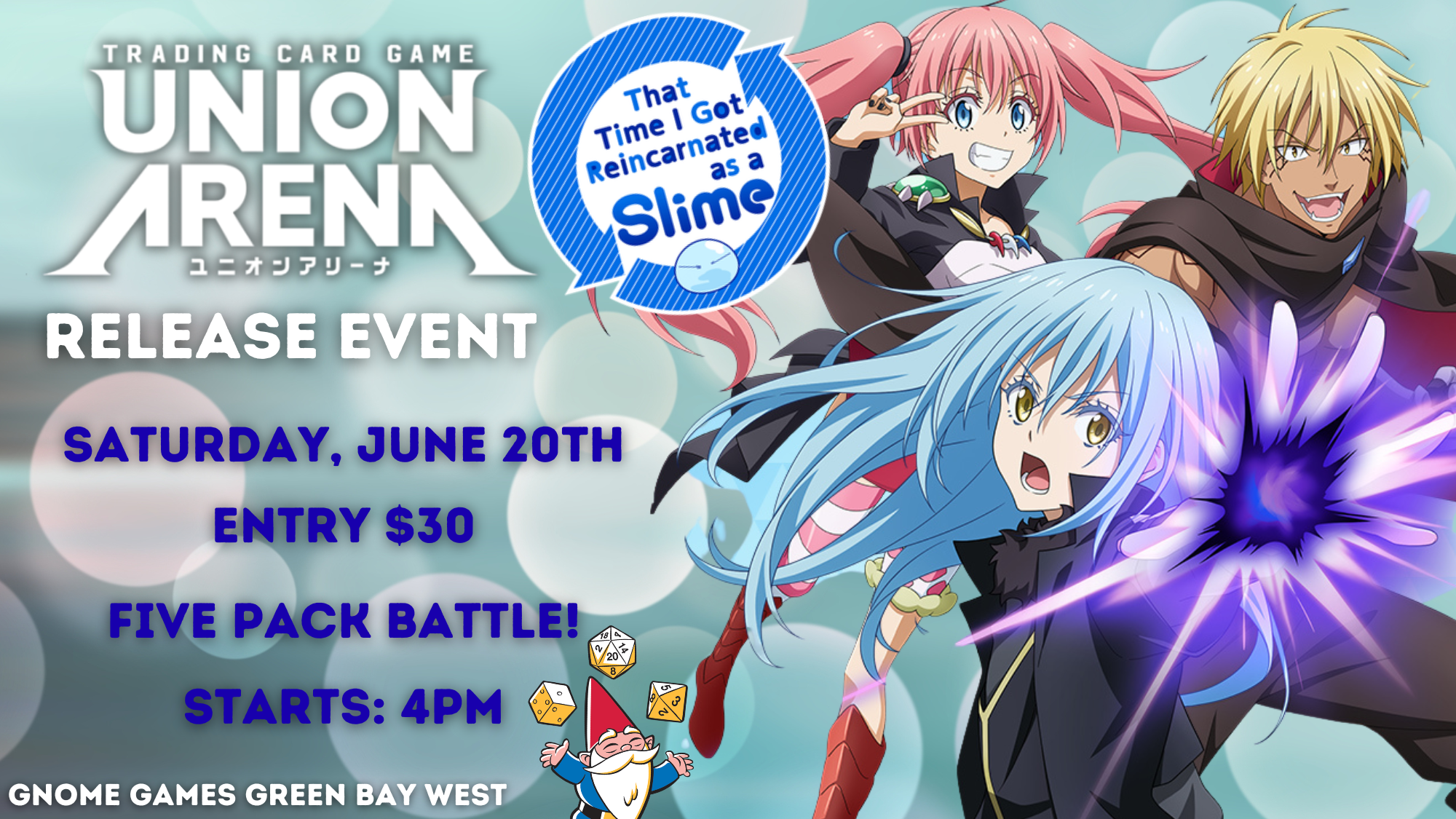
Join us at Gnome Games Green Bay West for our Union Arena: That Time I Got Reincarnated as a Slime (UE20BT) Release Event!
Join in the fun as the hit anime That Time I Got Reincarnated as a Slime joins Union Arena with our That Time I Got Reincarnated as a Slime (UE20BT) Release Event!
- Saturday, June 20th
- $30.00 Entry
- 4:00PM
This release event will be a 3 round Swiss-style Tournament. Players will open 5 packs of Slime and use them to build a deck to compete in matches. Each round won awards players with an additional pack! Each participant gets a Release Event Pack and a promotional card. One Winner will get a special Winner foil stamped promotional card!
How does Deckbuilding Work?
Because of how sealed events operate, decks can have more than four cards with the same card number. It can also contain more than four of each of the Special, Color, and Final trigger types. 5 booster packs contribute to creating as close to a 60 card deck as possible. A deck needs 3 Action Point cards, Raids can be performed using cards with two different colors, and five Special triggers can be in a deck. Bring your own sleeves from home or purchase some before the event!
For 5 Pack Battle Rules, Check HERE for more info!
For more information on how to play Union Arena, check here!
Interested in more Union Arena news? Check out their website!
More Union Arena Events can be found on our Gnome Games Event calendar!
*Players will need to register for the event on the Bandai TCG+, which can be found here!
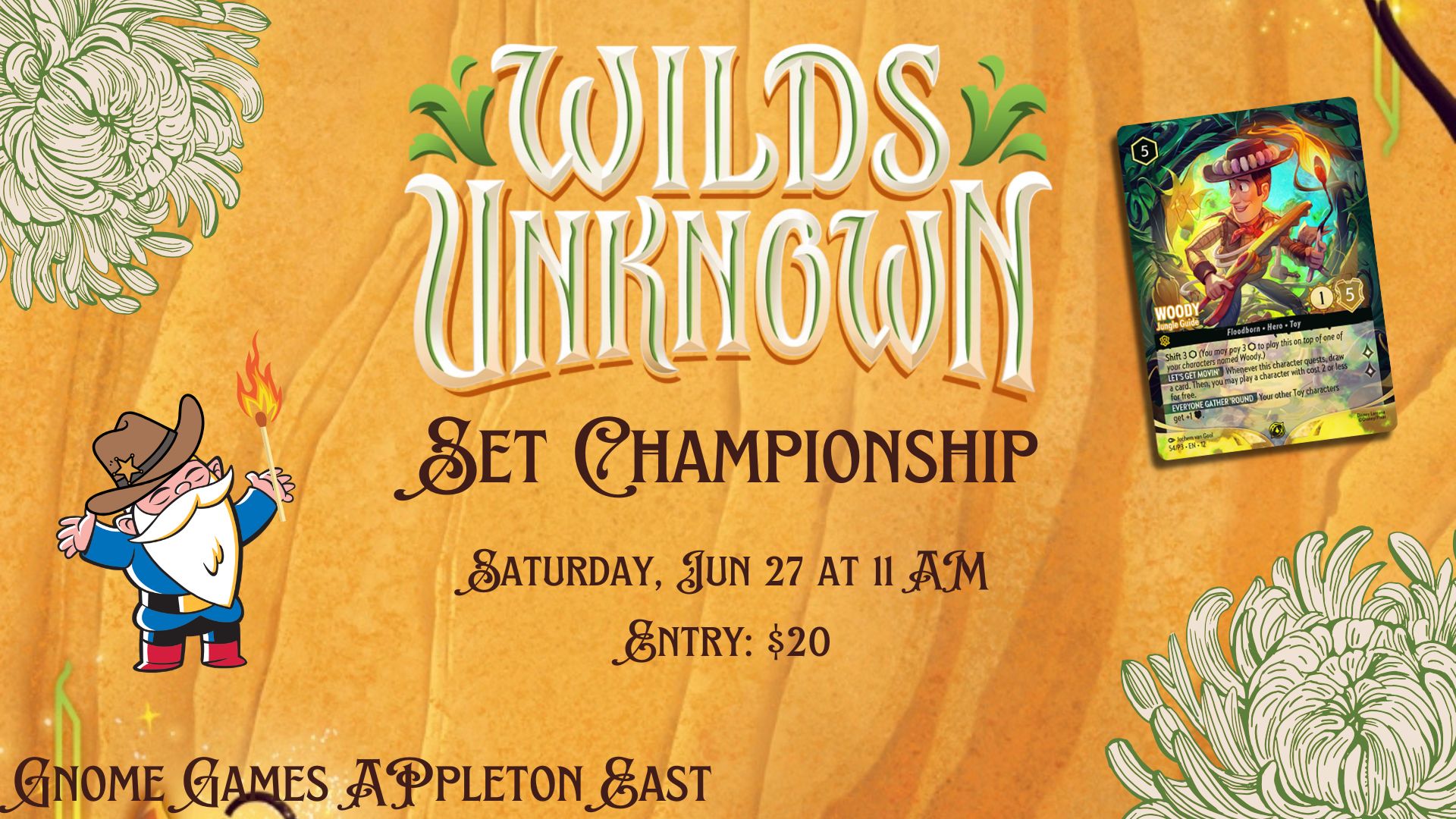
Join us at Gnome Games Appleton East for our Disney Lorcana Wilds Unknown Set Championship!
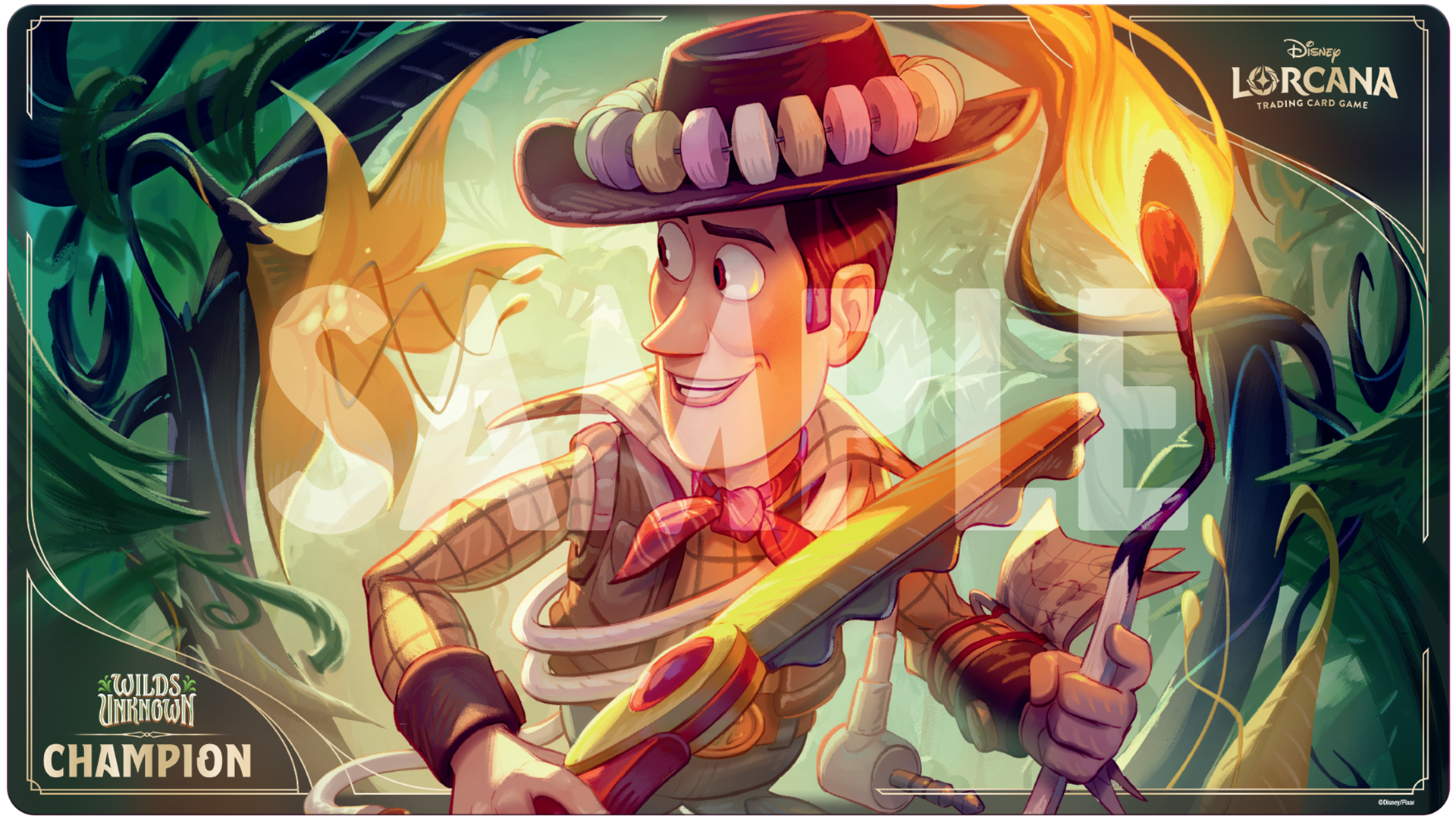
 On Saturday, June 27th at 11 AM, compete in an exclusive once-per-set tournament with our Wilds Unknown Set Championship! In this competitive level tournament, play through matches against others to find out who has the best deck, and who gets to go home with the exclusive Championship playmat! Rounds are based on attendance, with 5 rounds and Top 8 Top Cut being the highest possible amount with our event capacity. Rounds are 60 minutes, best of 3, and each match won awards players with an additional pack of Wilds Unknown! Each participant receives an Alternate art non-foil Woody – Jungle Guide promo card, Top 8 receive an Alternate art foil Woody – Jungle Guide promo card, and the grand Champion receives a Woody – Jungle Guide Champion playmat!
Entry is $20. Players must register ahead of time on the Ravensburger Play Hub. Our event is located here! Don’t have an account? Create one here!
What is the newest Lorcana set? Wilds Unknown!
You’ve seen the toys from Disney and Pixar’s Toy Story films make it through many perils in the past, but they’ve never faced threatening landscapes like those in the far-off corners of the realm. This is no time to be toying around, so make sure you have these trusty buddies in your decks!
Glimmers of the Parr family from The Incredibles are ready to speed, stretch, and fight their way into the realm. They’ve faced supervillains, but how you cleverly deploy their unique powers will be the difference between saving the day and defeat.
The princess glimmer Merida and others from her clan are ready to take aim at a victorious quest! Scottish accents are encouraged when enlisting the likes of Elinor, Fergus and more in your decks.
Interested in more Lorcana information? Check out their website!
Want to check out more Lorcana at Gnome Games? Take a peek at our calendar!
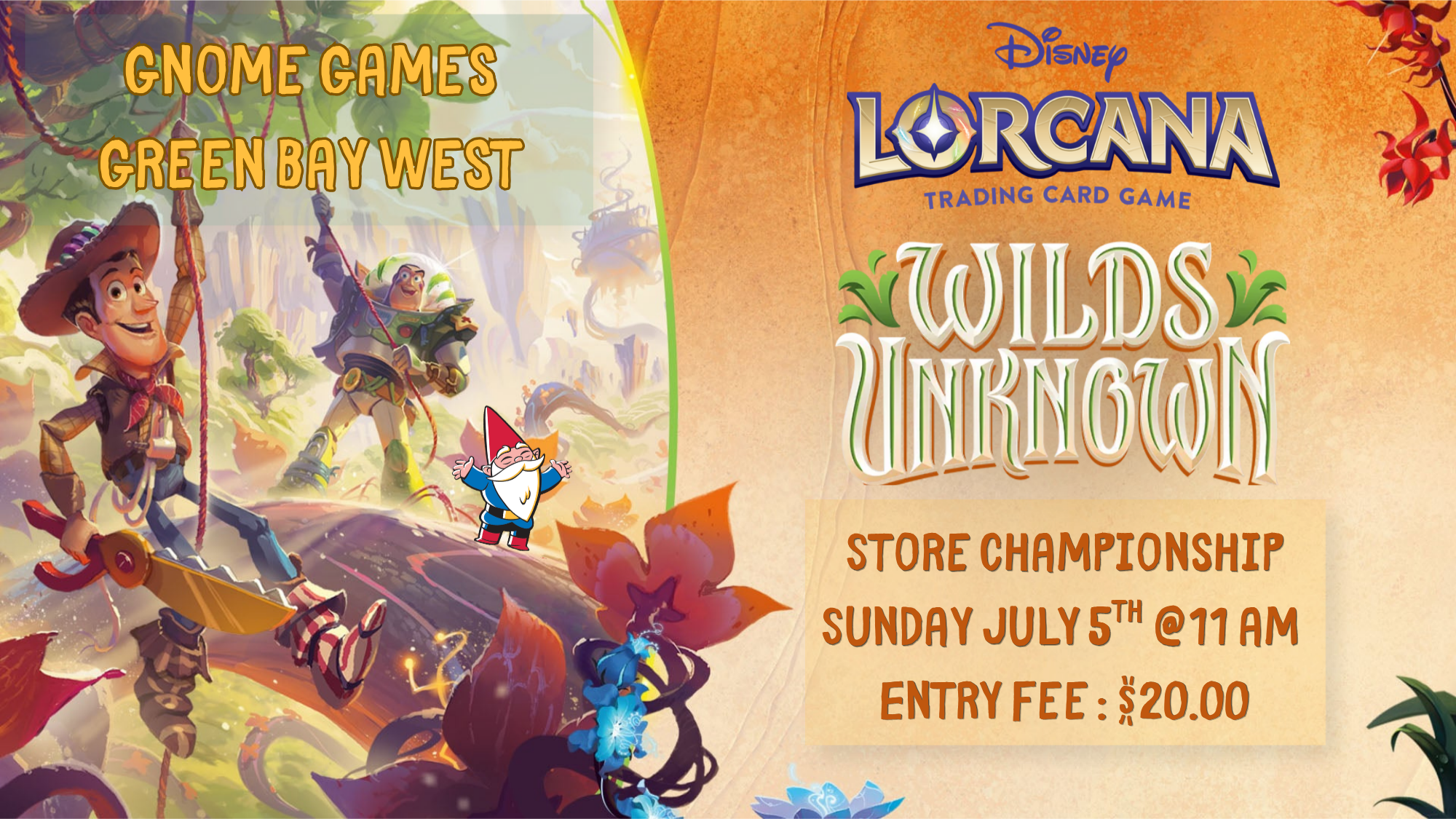
Join us for our Disney Lorcana Wilds Unknown Store Championship at Gnome Games Green Bay West!
- Sunday July 5th
- 11:00am
- $20.00 Entry
DECK LIST REQUIRED // STANDARD FORMAT // 8 PLAYER MINIMUM
Rounds based on attendance, with 5 rounds and Top 8 Top Cut being the max amount with event capacity (32 players). Rounds are 60 minutes, best of 3, and with each match won, players win an additional pack of Wilds Unknown!
Survive the brutal competition and you’ll be awarded with one of these incredible prizes!
Participation: Jungle Guide non-foil promo Top 8: 1 Woody – Jungle Guide foil promo
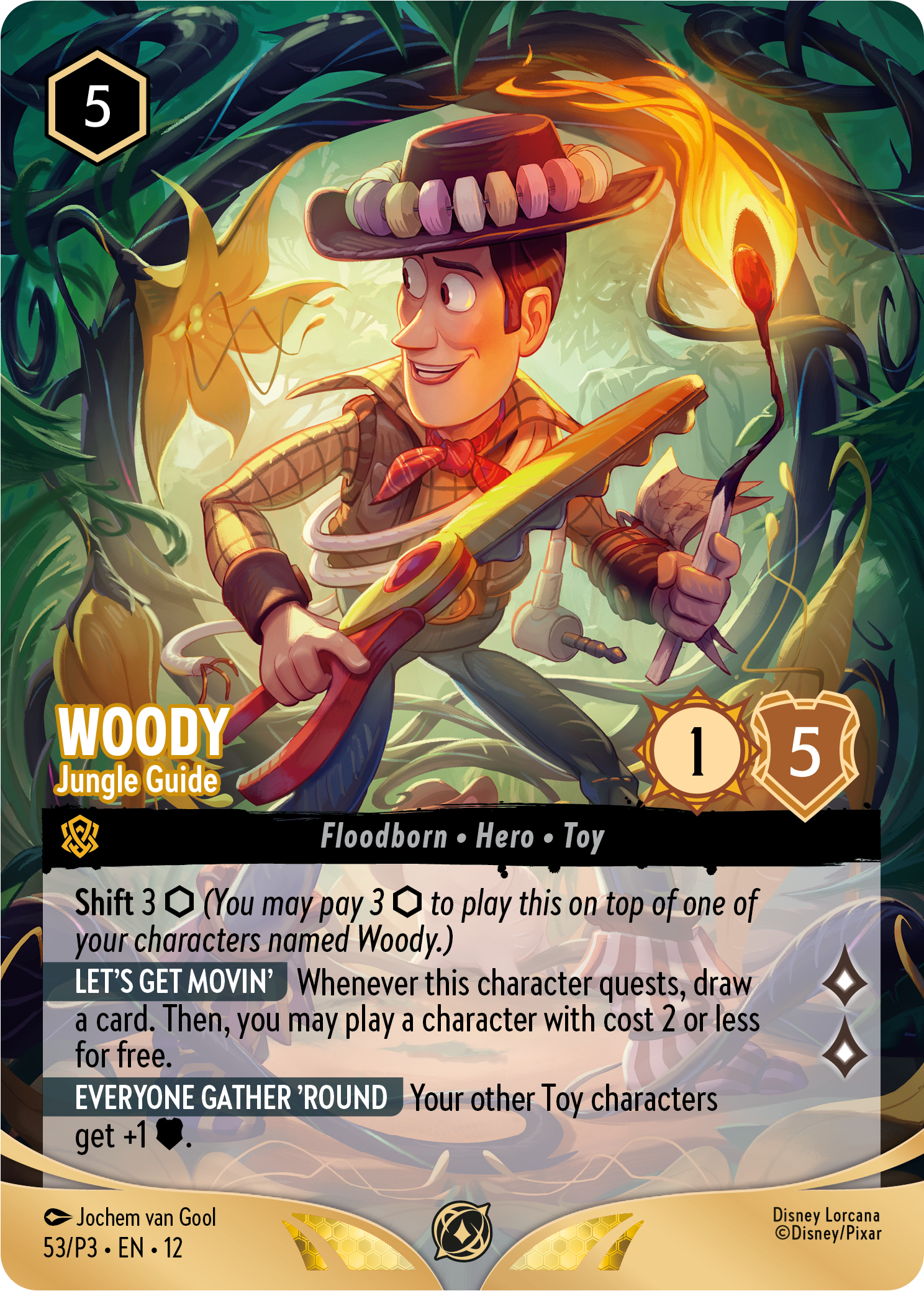
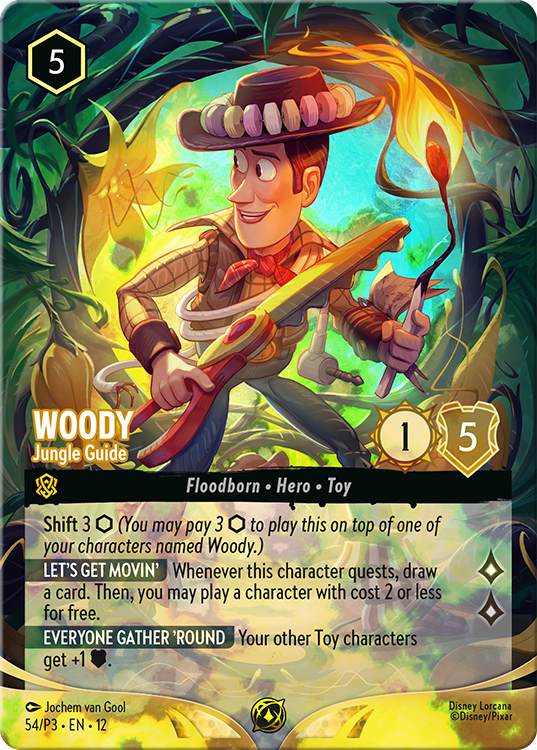
Champion: + 1 Woody – Jungle Guide foil promo card
**Players must register through the Ravensburger Play Hub. Don’t have an account? You can create one here!**
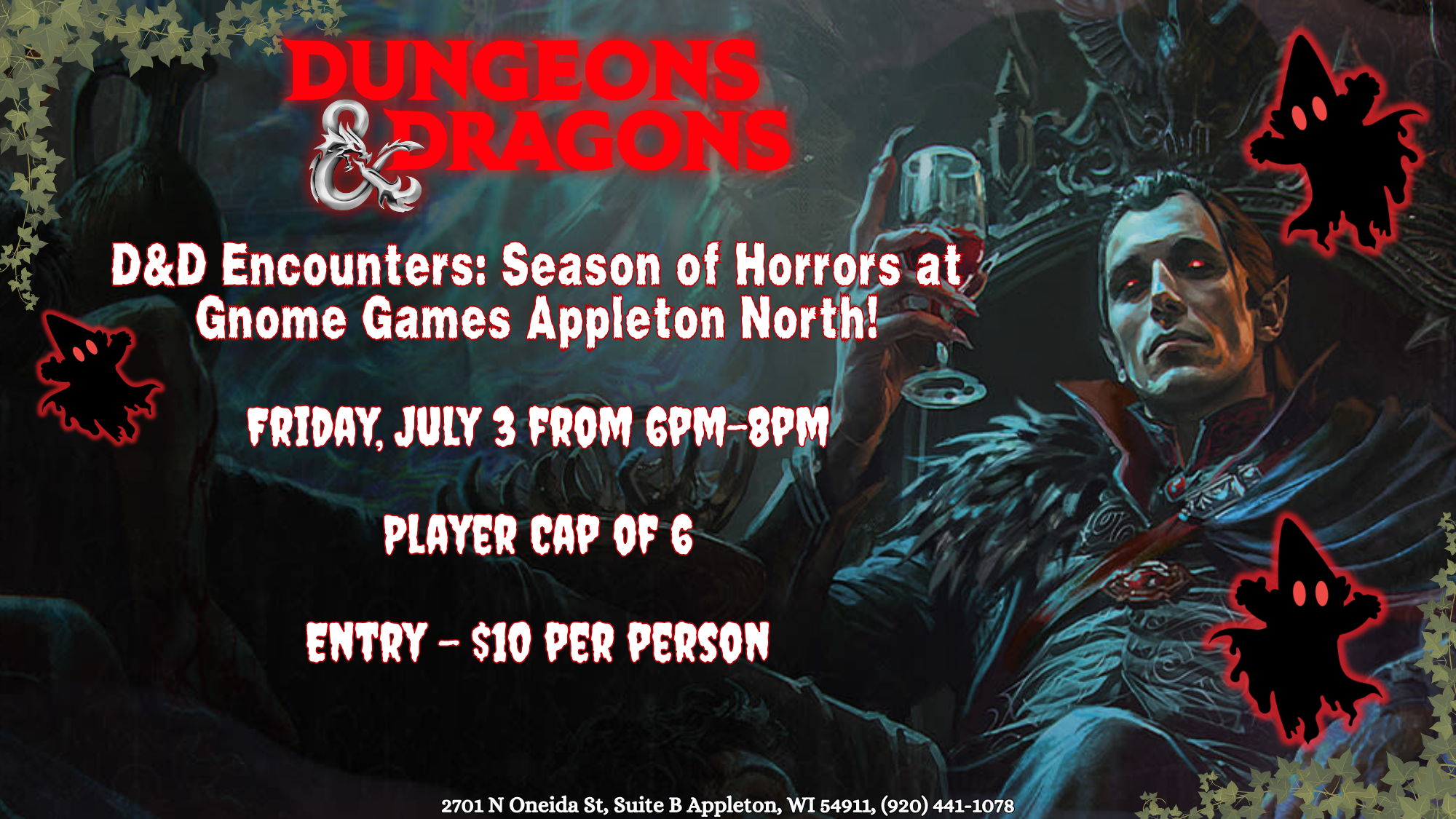
Dungeons and Dragons has come to Gnome Games Appleton North!
Join us in celebrating the Season of Horror with the release of Ravenloft: Horrors within!
Entry: $10
Friday, July 3 from 6pm to 8pm.
Play in a horror themed session centered on large, detailed encounters! Don’t worry if you missed out on the earlier events, each session includes a light narrative connection, making it easy for you to join at any time and without concern about missing previous weeks!
You will need an active Wizards Account to participate in the event. Don’t have one? Make yours here: https://myaccounts.wizards.com/register
Register for the event ahead of time with this Eventlink code: NMZN786
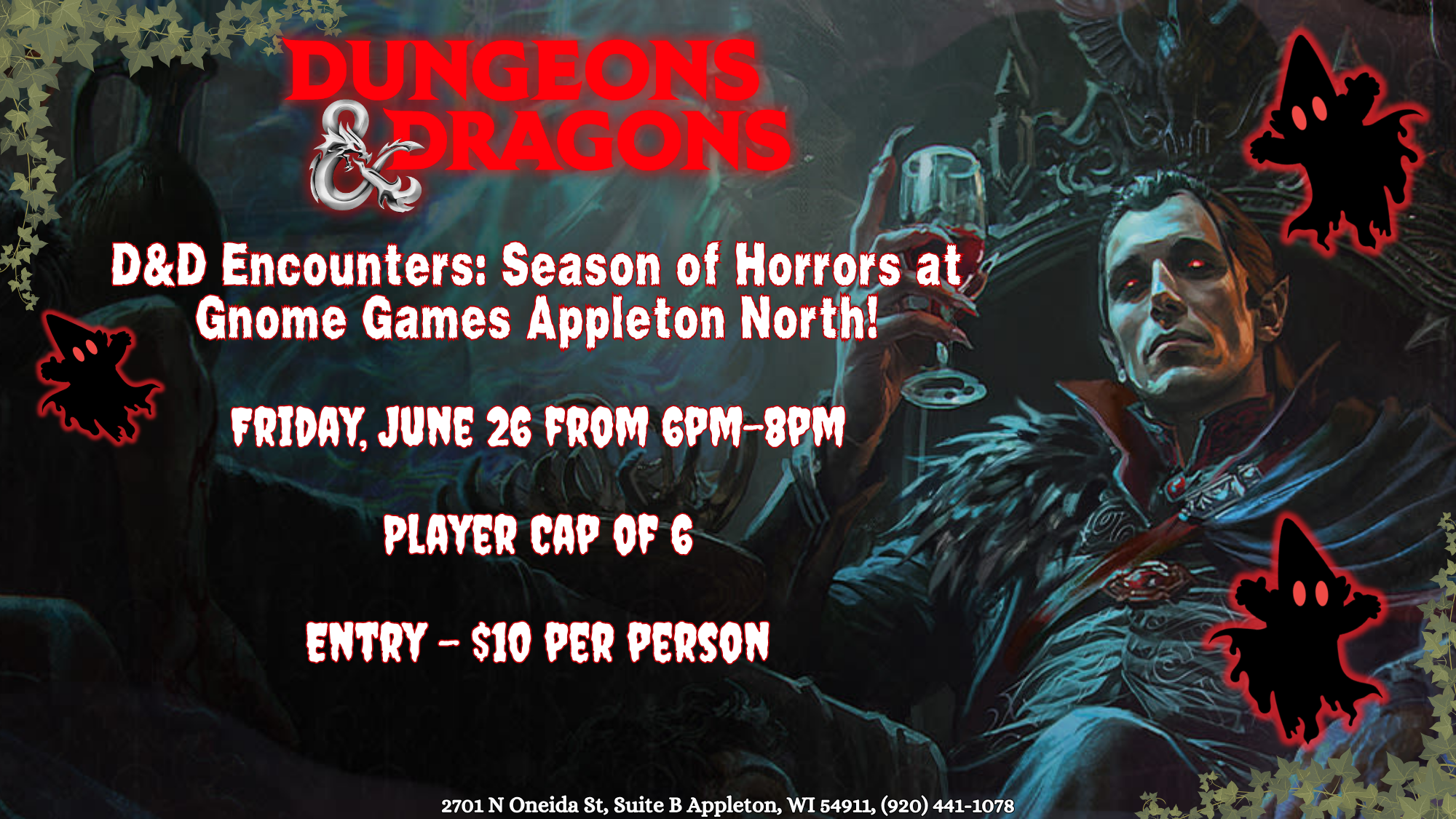
Dungeons and Dragons has come to Gnome Games Appleton North!
Join us in celebrating the Season of Horror with the release of Ravenloft: Horrors within!
Entry: $10
Friday, June 26 from 6pm to 8pm.
Play in a horror themed session centered on large, detailed encounters! Don’t worry if you missed out on the earlier events, each session includes a light narrative connection, making it easy for you to join at any time and without concern about missing previous weeks!
You will need an active Wizards Account to participate in the event. Don’t have one? Make yours here: https://myaccounts.wizards.com/register
Register for the event ahead of time with this Eventlink code: GXQ6Y5N