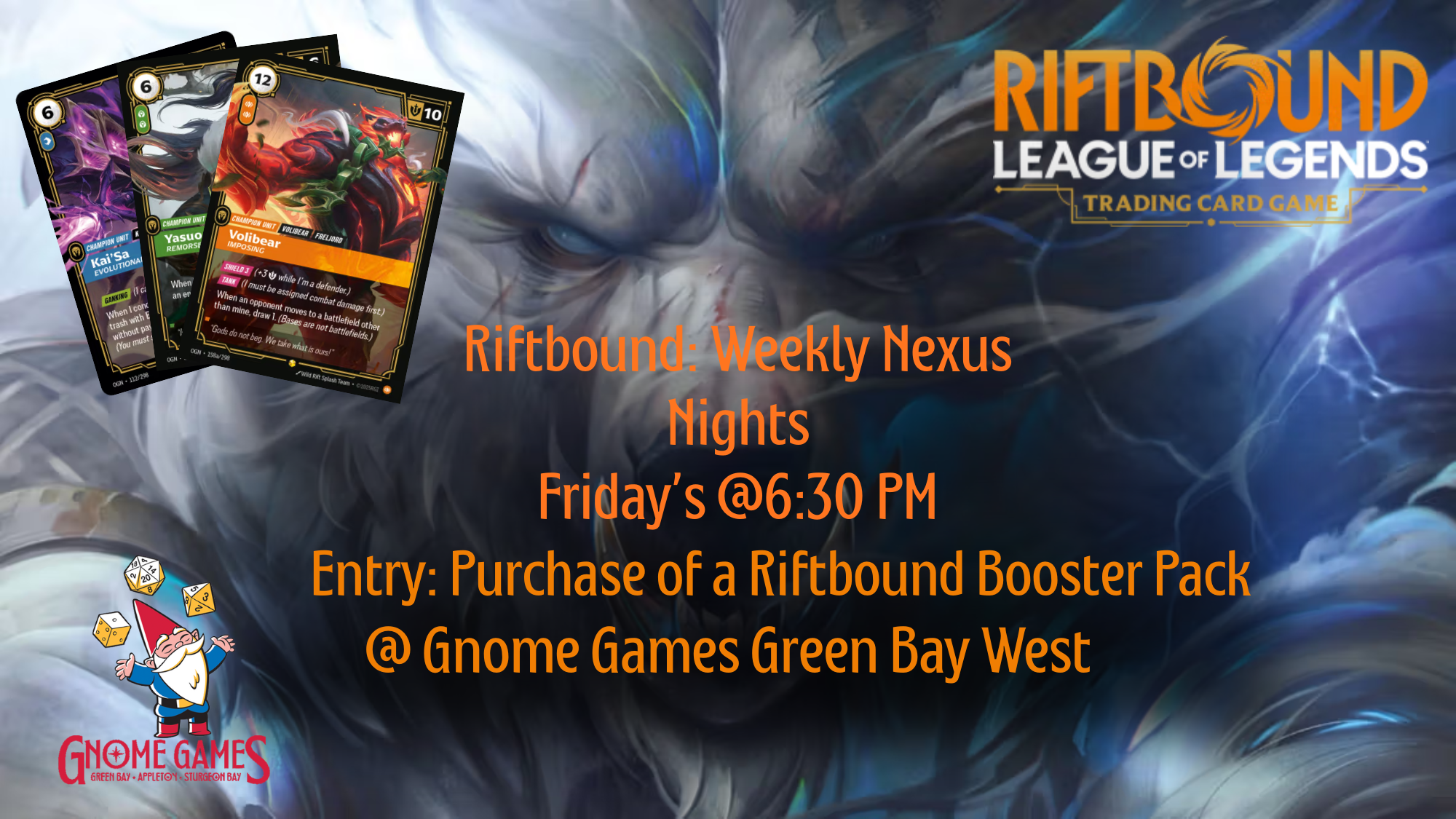
Join the Gnomes each Friday at 6:30pm for Riftbound’s Nexus Nights!
We’re inviting players out to play Riftbound in a variety of formats with a simple cost of purchasing a pack of Riftbound! Promos will go out based on attendance.
There are a multitude of formats available to play: 1 v 1, 2 v 2, or 3-4 player free for all! You’ll want to stay up to date with the most current errata or rules changes, some of which is available here: https://riftbound.leagueoflegends.com/en-us/news/rules-and-releases/riftbound-origins-card-errata/
If you’re looking for help building decks you might like information from the designers: https://riftbound.leagueoflegends.com/en-us/news/rules-and-releases/deckbuilding-primer/
The domains are:
- Fury (Red) –
- Fury is about aggression, passion, and the thrill of conquering.
- Fury decks often use damage-based removal, Accelerate (and other ways to enter ready), and rewards for conquering to achieve victory.
- Generally, Fury cards have a harder time drawing lots of cards or killing units directly, especially units that stay out of combat in their base.
- Examples of Fury from popular fiction are Conan the Barbarian, Blade, and Anakin Skywalker.
- Calm (Green) –
- Calm is about balance, meditation, and the peace of holding.
- Calm decks often use defensive tricks, moving enemies, and negating interaction (like counterspells and stuns) to defend their holds and achieve victory.
- Generally, Calm cards have a harder time being very aggressive or interacting without using their units.
- Examples of Calm from popular fiction are Gandalf, Baloo, and Obi Wan Kenobi.
- Mind (Blue) –
- Mind is about innovation, outsmarting opponents, and the benefits of intelligence and curiosity.
- Mind decks often use long-term planning, shrinking tricks, card draw, hidden and gear synergy to gain an advantage and achieve victory.
- Generally, Mind cards have a harder time with moving units or having efficient units.
- Examples of Mind from popular fiction are Sherlock Holmes, Curious George, and Yoda.
- Body (Orange) –
- Body is about physical superiority, agility, and connection to the wilds.
- Body decks often ramp their resources, play efficient and high impact units, and dominate combats to achieve victory.
- Generally, Body cards have a harder time with finding efficient card draw or noncombat spells.
- Examples of Body from popular fiction are The Terminator, Juggernaut, and Chewbacca.
- Chaos (Purple) –
- Chaos is about unpredictability, rebellion, and trickiness.
- Chaos decks often manipulate position and the trash, use hidden tricks, and filter toward the right cards to achieve victory.
- Generally, Chaos cards have a harder time permanently eliminating a threat or giving permanent advantages to its units.
- Examples of Chaos from popular fiction are V (for Vendetta), Spiderman, and Han Solo.
- Order (Yellow) –
- Order is about unity, community, and sacrifice for the greater good.
- Order decks often generate many small units, gain effects on unit death, and kill units directly to achieve victory.
- Generally, Order cards have a harder time dealing with smaller units and moving units.
- Examples of Order from popular fiction are Superman, Cobra Commander, and Leia Organa.
One way to start building a deck is to start with a domain you think fits your playstyle (or just style, generally) and search for cool cards you might want to fit into a deck.
Look for this and other events at our website: gnomegames.com/events/month!
Join the Gnomes each Friday at 6:30pm for Riftbound’s Nexus Nights!
We’re inviting players out to play Riftbound in a variety of formats with a simple cost of purchasing a pack of Riftbound! Promos will go out based on attendance.
There are a multitude of formats available to play: 1 v 1, 2 v 2, or 3-4 player free for all! You’ll want to stay up to date with the most current errata or rules changes, some of which is available here: https://riftbound.leagueoflegends.com/en-us/news/rules-and-releases/riftbound-origins-card-errata/
If you’re looking for help building decks you might like information from the designers: https://riftbound.leagueoflegends.com/en-us/news/rules-and-releases/deckbuilding-primer/
The domains are:
- Fury (Red) –
- Fury is about aggression, passion, and the thrill of conquering.
- Fury decks often use damage-based removal, Accelerate (and other ways to enter ready), and rewards for conquering to achieve victory.
- Generally, Fury cards have a harder time drawing lots of cards or killing units directly, especially units that stay out of combat in their base.
- Examples of Fury from popular fiction are Conan the Barbarian, Blade, and Anakin Skywalker.
- Calm (Green) –
- Calm is about balance, meditation, and the peace of holding.
- Calm decks often use defensive tricks, moving enemies, and negating interaction (like counterspells and stuns) to defend their holds and achieve victory.
- Generally, Calm cards have a harder time being very aggressive or interacting without using their units.
- Examples of Calm from popular fiction are Gandalf, Baloo, and Obi Wan Kenobi.
- Mind (Blue) –
- Mind is about innovation, outsmarting opponents, and the benefits of intelligence and curiosity.
- Mind decks often use long-term planning, shrinking tricks, card draw, hidden and gear synergy to gain an advantage and achieve victory.
- Generally, Mind cards have a harder time with moving units or having efficient units.
- Examples of Mind from popular fiction are Sherlock Holmes, Curious George, and Yoda.
- Body (Orange) –
- Body is about physical superiority, agility, and connection to the wilds.
- Body decks often ramp their resources, play efficient and high impact units, and dominate combats to achieve victory.
- Generally, Body cards have a harder time with finding efficient card draw or noncombat spells.
- Examples of Body from popular fiction are The Terminator, Juggernaut, and Chewbacca.
- Chaos (Purple) –
- Chaos is about unpredictability, rebellion, and trickiness.
- Chaos decks often manipulate position and the trash, use hidden tricks, and filter toward the right cards to achieve victory.
- Generally, Chaos cards have a harder time permanently eliminating a threat or giving permanent advantages to its units.
- Examples of Chaos from popular fiction are V (for Vendetta), Spiderman, and Han Solo.
- Order (Yellow) –
- Order is about unity, community, and sacrifice for the greater good.
- Order decks often generate many small units, gain effects on unit death, and kill units directly to achieve victory.
- Generally, Order cards have a harder time dealing with smaller units and moving units.
- Examples of Order from popular fiction are Superman, Cobra Commander, and Leia Organa.
One way to start building a deck is to start with a domain you think fits your playstyle (or just style, generally) and search for cool cards you might want to fit into a deck.
Look for this and other events at our website: gnomegames.com/events/month!
Join the Gnomes each Friday at 6:30pm for Riftbound’s Nexus Nights!
We’re inviting players out to play Riftbound in a variety of formats with a simple cost of purchasing a pack of Riftbound! Promos will go out based on attendance.
There are a multitude of formats available to play: 1 v 1, 2 v 2, or 3-4 player free for all! You’ll want to stay up to date with the most current errata or rules changes, some of which is available here: https://riftbound.leagueoflegends.com/en-us/news/rules-and-releases/riftbound-origins-card-errata/
If you’re looking for help building decks you might like information from the designers: https://riftbound.leagueoflegends.com/en-us/news/rules-and-releases/deckbuilding-primer/
The domains are:
- Fury (Red) –
- Fury is about aggression, passion, and the thrill of conquering.
- Fury decks often use damage-based removal, Accelerate (and other ways to enter ready), and rewards for conquering to achieve victory.
- Generally, Fury cards have a harder time drawing lots of cards or killing units directly, especially units that stay out of combat in their base.
- Examples of Fury from popular fiction are Conan the Barbarian, Blade, and Anakin Skywalker.
- Calm (Green) –
- Calm is about balance, meditation, and the peace of holding.
- Calm decks often use defensive tricks, moving enemies, and negating interaction (like counterspells and stuns) to defend their holds and achieve victory.
- Generally, Calm cards have a harder time being very aggressive or interacting without using their units.
- Examples of Calm from popular fiction are Gandalf, Baloo, and Obi Wan Kenobi.
- Mind (Blue) –
- Mind is about innovation, outsmarting opponents, and the benefits of intelligence and curiosity.
- Mind decks often use long-term planning, shrinking tricks, card draw, hidden and gear synergy to gain an advantage and achieve victory.
- Generally, Mind cards have a harder time with moving units or having efficient units.
- Examples of Mind from popular fiction are Sherlock Holmes, Curious George, and Yoda.
- Body (Orange) –
- Body is about physical superiority, agility, and connection to the wilds.
- Body decks often ramp their resources, play efficient and high impact units, and dominate combats to achieve victory.
- Generally, Body cards have a harder time with finding efficient card draw or noncombat spells.
- Examples of Body from popular fiction are The Terminator, Juggernaut, and Chewbacca.
- Chaos (Purple) –
- Chaos is about unpredictability, rebellion, and trickiness.
- Chaos decks often manipulate position and the trash, use hidden tricks, and filter toward the right cards to achieve victory.
- Generally, Chaos cards have a harder time permanently eliminating a threat or giving permanent advantages to its units.
- Examples of Chaos from popular fiction are V (for Vendetta), Spiderman, and Han Solo.
- Order (Yellow) –
- Order is about unity, community, and sacrifice for the greater good.
- Order decks often generate many small units, gain effects on unit death, and kill units directly to achieve victory.
- Generally, Order cards have a harder time dealing with smaller units and moving units.
- Examples of Order from popular fiction are Superman, Cobra Commander, and Leia Organa.
One way to start building a deck is to start with a domain you think fits your playstyle (or just style, generally) and search for cool cards you might want to fit into a deck.
Look for this and other events at our website: gnomegames.com/events/month!
Join the Gnomes each Friday at 6:30pm for Riftbound’s Nexus Nights!
We’re inviting players out to play Riftbound in a variety of formats with a simple cost of purchasing a pack of Riftbound! Promos will go out based on attendance.
There are a multitude of formats available to play: 1 v 1, 2 v 2, or 3-4 player free for all! You’ll want to stay up to date with the most current errata or rules changes, some of which is available here: https://riftbound.leagueoflegends.com/en-us/news/rules-and-releases/riftbound-origins-card-errata/
If you’re looking for help building decks you might like information from the designers: https://riftbound.leagueoflegends.com/en-us/news/rules-and-releases/deckbuilding-primer/
The domains are:
- Fury (Red) –
- Fury is about aggression, passion, and the thrill of conquering.
- Fury decks often use damage-based removal, Accelerate (and other ways to enter ready), and rewards for conquering to achieve victory.
- Generally, Fury cards have a harder time drawing lots of cards or killing units directly, especially units that stay out of combat in their base.
- Examples of Fury from popular fiction are Conan the Barbarian, Blade, and Anakin Skywalker.
- Calm (Green) –
- Calm is about balance, meditation, and the peace of holding.
- Calm decks often use defensive tricks, moving enemies, and negating interaction (like counterspells and stuns) to defend their holds and achieve victory.
- Generally, Calm cards have a harder time being very aggressive or interacting without using their units.
- Examples of Calm from popular fiction are Gandalf, Baloo, and Obi Wan Kenobi.
- Mind (Blue) –
- Mind is about innovation, outsmarting opponents, and the benefits of intelligence and curiosity.
- Mind decks often use long-term planning, shrinking tricks, card draw, hidden and gear synergy to gain an advantage and achieve victory.
- Generally, Mind cards have a harder time with moving units or having efficient units.
- Examples of Mind from popular fiction are Sherlock Holmes, Curious George, and Yoda.
- Body (Orange) –
- Body is about physical superiority, agility, and connection to the wilds.
- Body decks often ramp their resources, play efficient and high impact units, and dominate combats to achieve victory.
- Generally, Body cards have a harder time with finding efficient card draw or noncombat spells.
- Examples of Body from popular fiction are The Terminator, Juggernaut, and Chewbacca.
- Chaos (Purple) –
- Chaos is about unpredictability, rebellion, and trickiness.
- Chaos decks often manipulate position and the trash, use hidden tricks, and filter toward the right cards to achieve victory.
- Generally, Chaos cards have a harder time permanently eliminating a threat or giving permanent advantages to its units.
- Examples of Chaos from popular fiction are V (for Vendetta), Spiderman, and Han Solo.
- Order (Yellow) –
- Order is about unity, community, and sacrifice for the greater good.
- Order decks often generate many small units, gain effects on unit death, and kill units directly to achieve victory.
- Generally, Order cards have a harder time dealing with smaller units and moving units.
- Examples of Order from popular fiction are Superman, Cobra Commander, and Leia Organa.
One way to start building a deck is to start with a domain you think fits your playstyle (or just style, generally) and search for cool cards you might want to fit into a deck.
Look for this and other events at our website: gnomegames.com/events/month!
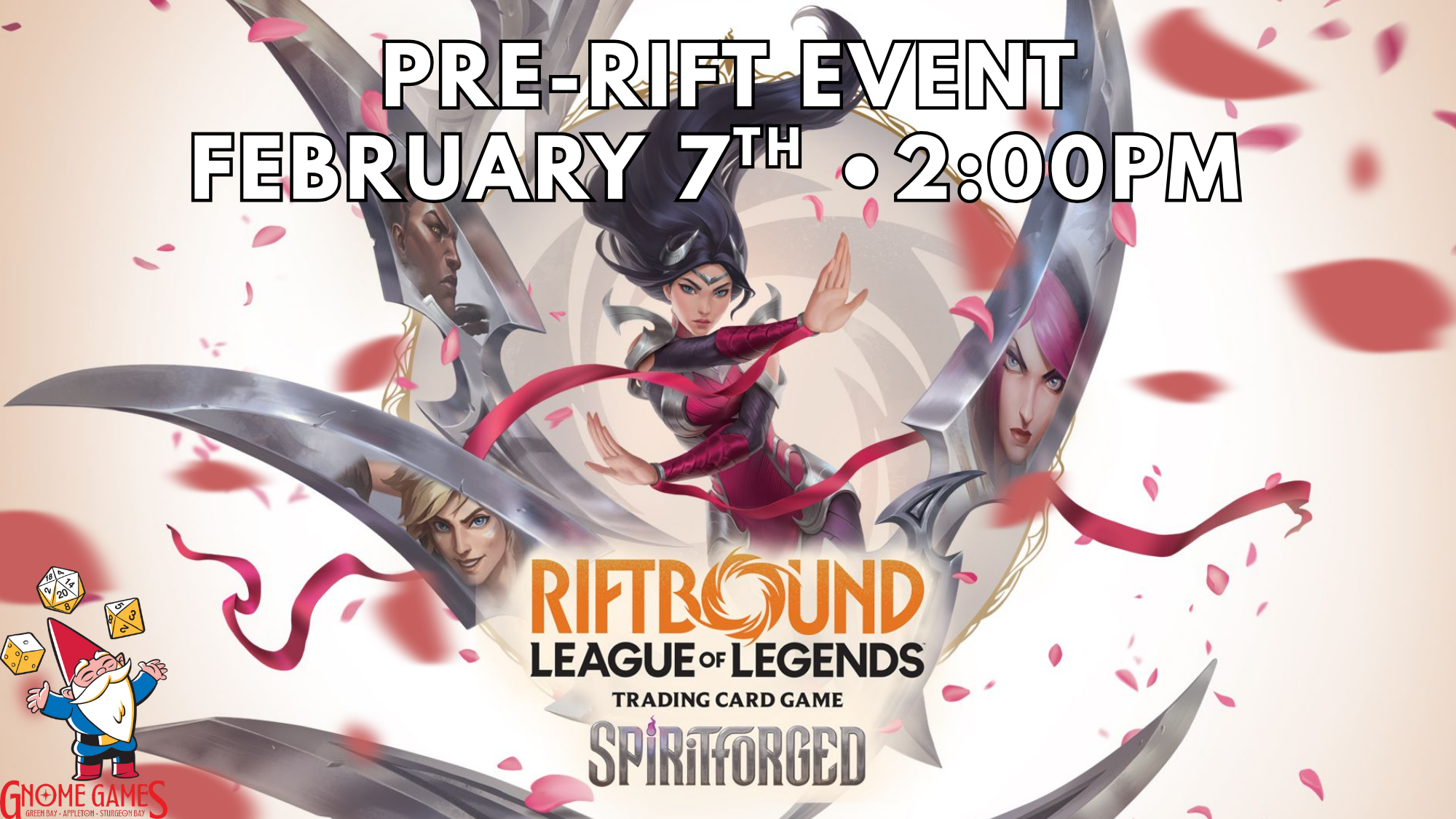
Join us at Gnome Games for a Riftbound Spiritforged Pre-Rift Event!
Saturday, February 7th
Starting at 2:00pm
Entry is 35*
Riftbound is the League of Legends trading card game, a game for 2-4 players where you choose your champion and send them alongside your army and your spells to take control of battlefields and win!
Sealed Deck is a limited format where players are provided with 6 unopened booster packs to construct their deck of (25) cards. A champion is not required, any three domains, and any signature spells that fit into your chosen domains are used for deck building in a sealed event. Otherwise deck building is the same. For additional deck building info check here! And for more Spiritforged Information, check here.
For more Gnome Games Events at all our Locations check here!

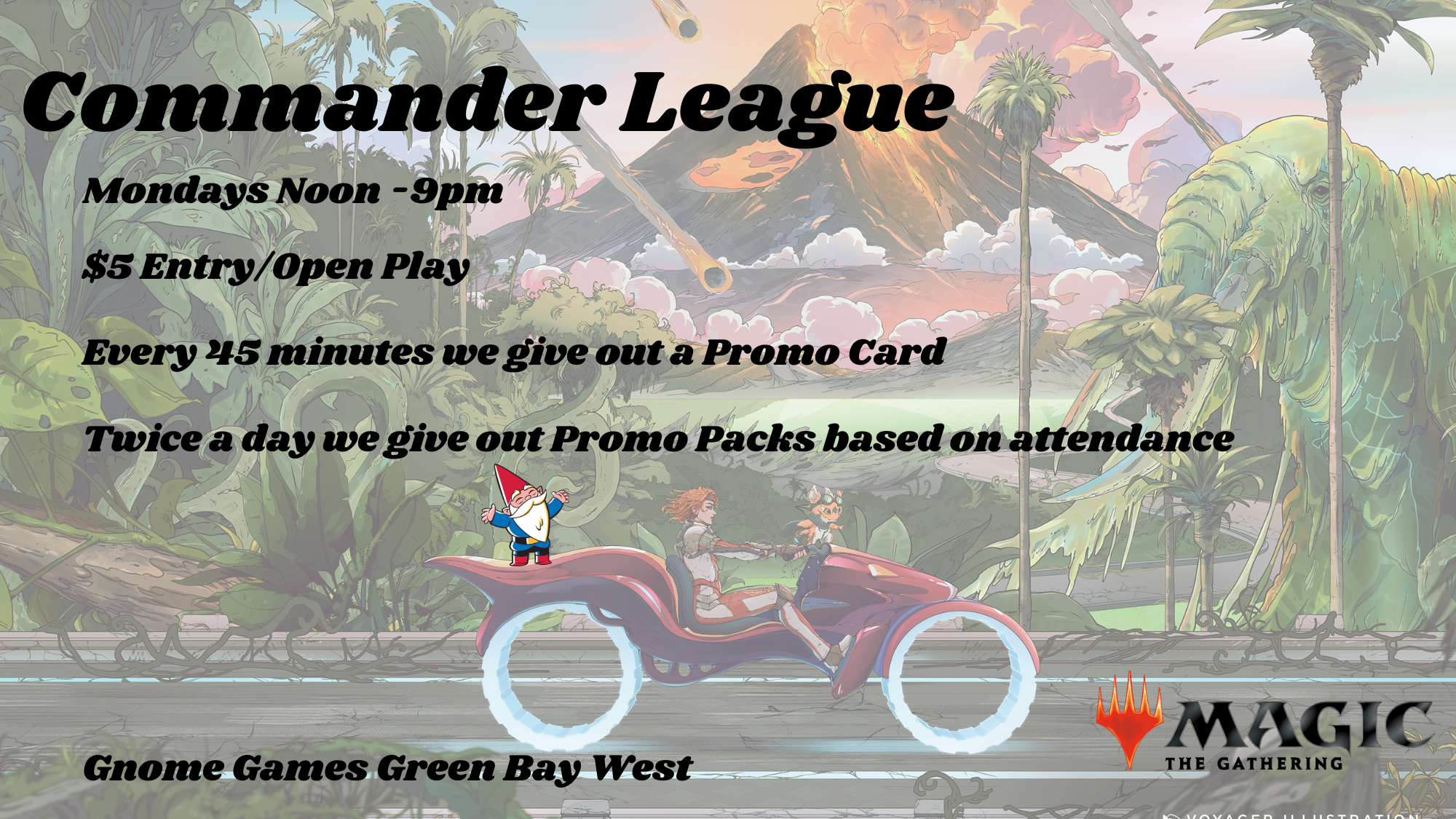
Commander Monday at Gnome Games Green Bay West! We’re running Commander all day, but you can come whenever you like!
12pm – 9pm.
Entry is either $5 or purchase of $5 of product (that’s just a booster or two)!
All skill levels welcome. Grab your favorite Commander Deck and we’ll see you for Monday Commander League!
Promos are awarded randomly throughout the afternoon and evening!
For more information on the Commander Format visit https://magic.wizards.com/en/formats/commander
“This format is for four players per game and deck sizes are 99 cards + 1 commander card. The game duration for this format should be about 20 minutes per player.
The Commander format is all about picking your hero and building a deck around them. In this casual, multiplayer format, you choose a legendary creature to serve as your commander and build the rest of your deck around their color identity and unique abilities. Players are only allowed one of each card in their deck, with the exception of basic lands, but they can use cards from throughout Magic’s history.”
Current Commander Banned list.
Look for Magic products available at Gnome here!
EVENTLINK CODES for Magic: The Gathering Companion App:
@Noon: YEY872J
@4pm: 653ZV36
Commander Monday at Gnome Games Green Bay West! We’re running Commander all day, but you can come whenever you like!
12pm – 9pm.
Entry is either $5 or purchase of $5 of product (that’s just a booster or two)!
All skill levels welcome. Grab your favorite Commander Deck and we’ll see you for Monday Commander League!
Promos are awarded randomly throughout the afternoon and evening!
For more information on the Commander Format visit https://magic.wizards.com/en/formats/commander
“This format is for four players per game and deck sizes are 99 cards + 1 commander card. The game duration for this format should be about 20 minutes per player.
The Commander format is all about picking your hero and building a deck around them. In this casual, multiplayer format, you choose a legendary creature to serve as your commander and build the rest of your deck around their color identity and unique abilities. Players are only allowed one of each card in their deck, with the exception of basic lands, but they can use cards from throughout Magic’s history.”
Current Commander Banned list.
Look for Magic products available at Gnome here!
EVENTLINK CODES for Magic: The Gathering Companion App:
@Noon:ZQWZMRW
@4pm: 3JENYEQ
Commander Monday at Gnome Games Green Bay West! We’re running Commander all day, but you can come whenever you like!
12pm – 9pm.
Entry is either $5 or purchase of $5 of product (that’s just a booster or two)!
All skill levels welcome. Grab your favorite Commander Deck and we’ll see you for Monday Commander League!
Promos are awarded randomly throughout the afternoon and evening!
For more information on the Commander Format visit https://magic.wizards.com/en/formats/commander
“This format is for four players per game and deck sizes are 99 cards + 1 commander card. The game duration for this format should be about 20 minutes per player.
The Commander format is all about picking your hero and building a deck around them. In this casual, multiplayer format, you choose a legendary creature to serve as your commander and build the rest of your deck around their color identity and unique abilities. Players are only allowed one of each card in their deck, with the exception of basic lands, but they can use cards from throughout Magic’s history.”
Current Commander Banned list.
Look for Magic products available at Gnome here!
EVENTLINK CODES for Magic: The Gathering Companion App:
@Noon: 864W38D
@4pm: J23W737

 February Pokémon TCG League Challenge – Green Bay East
Join the Gnomes for a Pokémon Tournament Sunday at Gnome Game Green Bay East! Mega Evolution – Ascended Heroes will be legal for this Challenge.
League Challenge
Registration opens at 12:30pm and begins at 1:00pm
Decklists are required – Download one here
League Challenge Entry:
Juniors (Age 10 & Under) $5
Seniors (11 – 14) $5
Masters $10
This will be a Swiss Rounds only event with each rounds being a best of 1 game match with a 30 minute time limit.
Win a Match Win a Booster, with Promo Packs going out to all players after Round 1.
Championship Points are awarded based on attendance. For more information visit here!
Watch for other events here!
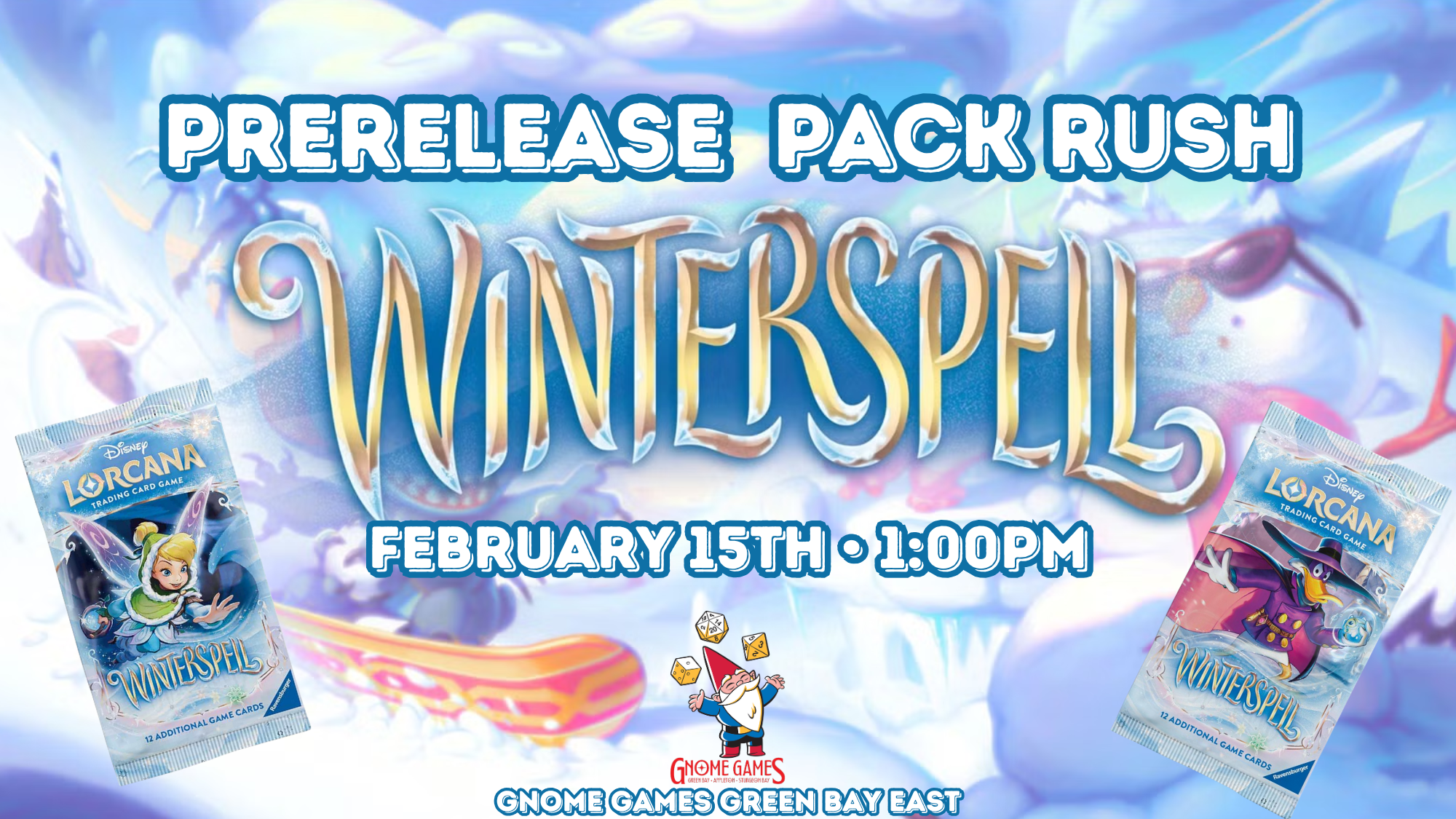
Winterspell is here early at Gnome Games Green Bay East!
To celebrate we’ll be hosting Prerelease Events all weekend long! Come get some of the newest set early at Gnome Games! Our Pack Rush Prerelease will be a Swiss 3 Round Event, where after entry you’ll get another pack of Winterspell!
Our event in on Sunday Feb 15th,
Entry is $20*
Registration begins at 1:00pm!

What is Pack Rush?
Register for our event on Carde.io here!: Carde.io
Check out all our other Prerelease events here!: Disney Lorcana Prerelease events!
*Prices are subject to change.