Pokémon Day 2026 at Gnome Games Green Bay West

Green Bay West

Join us at Gnome Games Green Bay West for Pokémon Day 2026!

On Saturday, February 28th we’re celebrating Pokémon Day 2026! This year marks the 30th anniversary of Pokémon!
Starting from open at 10 AM and running all day we’ll have creative activities, exclusive promos, and more!

Challenge the professor to receive prizes, Pokémon Prize Packs, and most importantly, bragging rights. Will you beat the Professor and claim victory?

We’re also hosting exclusive giveaways for Pokémon products throughout the day! Come in, participate in an activity, challenge the Professor, and more to get entered in for various prizes!

Drawings for prizes will occur at 5pm; we’ll take information to contact winners as part of the drawings!

How do you get entries?

  • Participating in Pokémon Club*
  • Making a Pokémon craft*
  • Coming in Costume.*
  • Playing a Pokémon video game. (Including Pokémon TCG Pocket)*
  • Playing the Professor: Challenge one of the Gnomes to a Pokémon TCG Battle!*

*Some activities will also get you promo cards or prize packs!

What is Pokémon Day?

Every year on February 27, Pokémon fans around the world celebrate Pokémon Day to commemorate the release of the very first Pokémon video games in Japan. These games were Pokémon Red and Pokémon Green,  originally released on 27 February 1996! Now, Pokémon has grown into a worldwide phenomenon that brings joy to various parts of people’s lives.

Take a look at the Pokémon website for news, information, events and more!

Our Gnome Games calendar has more Pokémon events to see!

Magic: Avatar’s Master the Four Elements – Gnome West Tuesdays

Gnome West

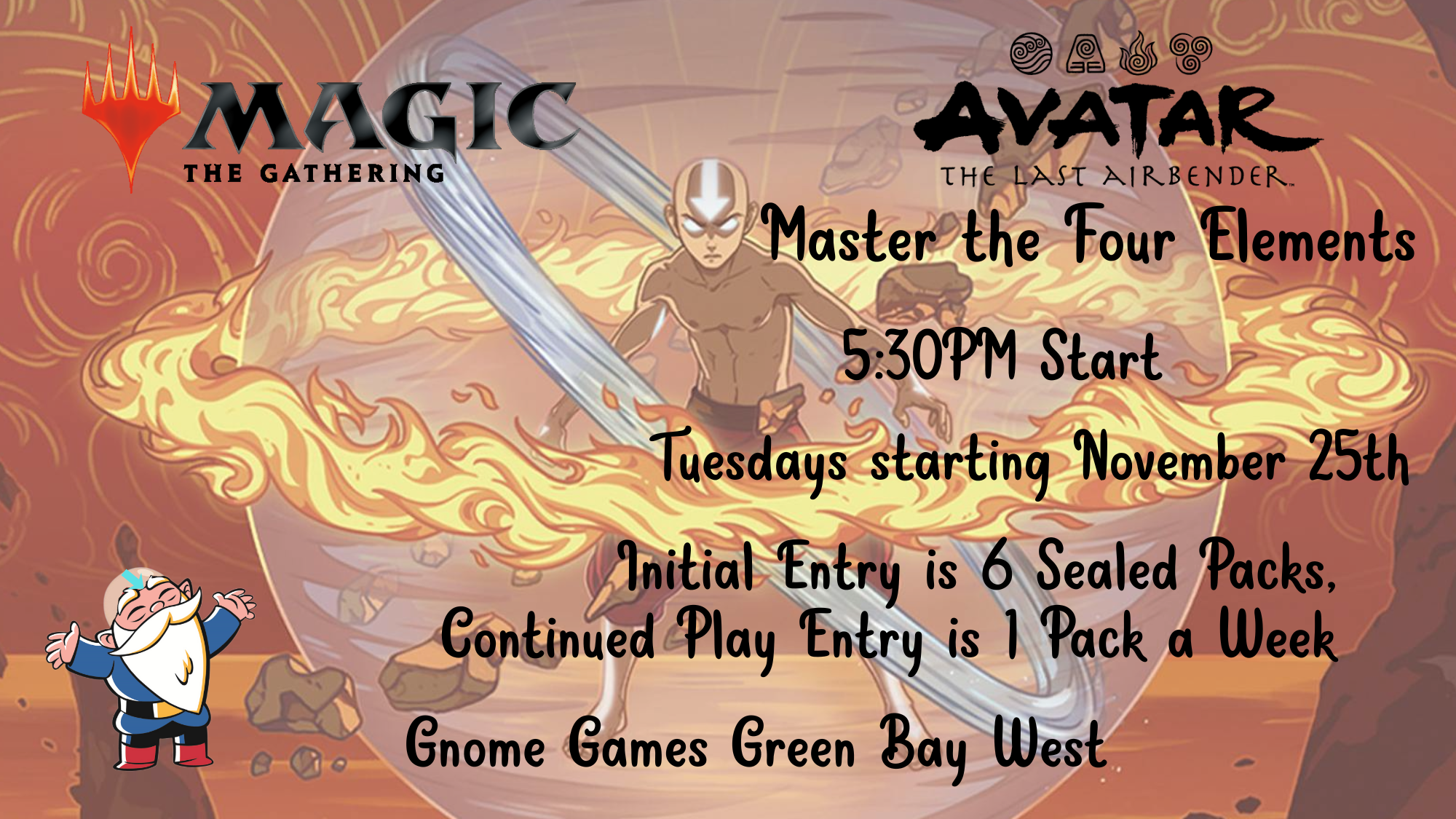
Do you have what it takes to Master the Four Elements of Avatar’s The Last Airbender? Gnome invites you to try with this special sealed event each Tuesday at 5:30pm-8:30pm!

Preregister with the Companion code: 65N3EG7

Players begin by purchasing six Magic: The Gathering | Avatar: The Last Airbender Play Boosters and selecting one of four emblems:
Air
Water
Earth
Fire

Emblems grant players unique benefits during games.

As the league progresses, players collect the remaining emblems through continued participation. With their Play Boosters in hand, players build a 40-card sealed deck to play against other opponents over the term of the program. (Gnome provides the basic lands!)

Each week players return they purchase an additional booster and add it to their card pool as well as get a chance at another emblem.

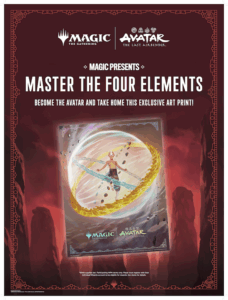
At the end of each match, players ask their opponents to sign the back of their emblem card they used in that game. Once a player has collected all four emblems, and each emblem has three signatures on the back, they can present them to the store to receive the foil art print reward!

What is the Sealed Deck format?

Build a deck from 6 unopened booster packs, the deck is a Minimum of 40 cards with no maximum, as long as you can shuffle your deck unassisted.

There is no limit to number of individual cards that can be played. For example, having 5 or more of an individual card is permitted.

Study up on some Avatar mechanics and watch for additional Magic events on our calendar!

Firebending is a keyword that always includes a number. Whenever a creature you control with firebending attacks, you add that much red mana. You don’t lose this mana during that combat. Any of this mana you still have as combat ends will be lost. You won’t have it during your second main phase.

Airbend is a keyword action. To airbend a permanent or a spell, you exile it. As long as that card remains exiled, its owner may cast it by paying rather than paying its mana cost. This doesn’t change when that card can be cast. If you airbend a creature that an opponent owns during your turn (notably something Appa can’t do unless you control that creature, but other cards can), they’ll usually have to wait until their next turn to cast it again.

Waterbend is a cost and always includes an amount of mana that must be paid … somehow. More on that in a moment. Waterbend costs can appear as an additional cost to cast a spell, as part of an ability’s activation cost, or anywhere else you might be asked to pay mana.

To pay a waterbend cost, you can always just pay the requested mana. However, for each 1 mana in that cost, you can tap an untapped artifact or creature you control rather than pay that mana. If you choose to tap a creature to help pay a waterbend cost, it can be one that just came under your control that turn.

Earthbend is another keyword action that includes a number. When you earthbend, choose target land you control. As the earthbend ability resolves, that land becomes a 0/0 creature with haste that’s still a land. Then put +1/+1 counters on it equal to the earthbend number. Because the new creature land will have haste, you can feel free to earthbend lands that you just played. There is no summoning sickness in Ba Sing Se.

Magic: Avatar’s Master the Four Elements – Gnome West Tuesdays

Gnome West

Do you have what it takes to Master the Four Elements of Avatar’s The Last Airbender? Gnome invites you to try with this special sealed event each Tuesday at 5:30pm-8:30pm!

Preregister with the Companion code: 3JWEZME

Players begin by purchasing six Magic: The Gathering | Avatar: The Last Airbender Play Boosters and selecting one of four emblems:
Air
Water
Earth
Fire

Emblems grant players unique benefits during games.

As the league progresses, players collect the remaining emblems through continued participation. With their Play Boosters in hand, players build a 40-card sealed deck to play against other opponents over the term of the program. (Gnome provides the basic lands!)

Each week players return they purchase an additional booster and add it to their card pool as well as get a chance at another emblem.

At the end of each match, players ask their opponents to sign the back of their emblem card they used in that game. Once a player has collected all four emblems, and each emblem has three signatures on the back, they can present them to the store to receive the foil art print reward!

What is the Sealed Deck format?

Build a deck from 6 unopened booster packs, the deck is a Minimum of 40 cards with no maximum, as long as you can shuffle your deck unassisted.

There is no limit to number of individual cards that can be played. For example, having 5 or more of an individual card is permitted.

Study up on some Avatar mechanics and watch for additional Magic events on our calendar!

Firebending is a keyword that always includes a number. Whenever a creature you control with firebending attacks, you add that much red mana. You don’t lose this mana during that combat. Any of this mana you still have as combat ends will be lost. You won’t have it during your second main phase.

Airbend is a keyword action. To airbend a permanent or a spell, you exile it. As long as that card remains exiled, its owner may cast it by paying rather than paying its mana cost. This doesn’t change when that card can be cast. If you airbend a creature that an opponent owns during your turn (notably something Appa can’t do unless you control that creature, but other cards can), they’ll usually have to wait until their next turn to cast it again.

Waterbend is a cost and always includes an amount of mana that must be paid … somehow. More on that in a moment. Waterbend costs can appear as an additional cost to cast a spell, as part of an ability’s activation cost, or anywhere else you might be asked to pay mana.

To pay a waterbend cost, you can always just pay the requested mana. However, for each 1 mana in that cost, you can tap an untapped artifact or creature you control rather than pay that mana. If you choose to tap a creature to help pay a waterbend cost, it can be one that just came under your control that turn.

Earthbend is another keyword action that includes a number. When you earthbend, choose target land you control. As the earthbend ability resolves, that land becomes a 0/0 creature with haste that’s still a land. Then put +1/+1 counters on it equal to the earthbend number. Because the new creature land will have haste, you can feel free to earthbend lands that you just played. There is no summoning sickness in Ba Sing Se.

Magic: Avatar’s Master the Four Elements – Gnome West Tuesdays

Gnome West

Do you have what it takes to Master the Four Elements of Avatar’s The Last Airbender? Gnome invites you to try with this special sealed event each Tuesday at 5:30pm-8:30pm!

Preregister with the Companion code: J2538ED

Players begin by purchasing six Magic: The Gathering | Avatar: The Last Airbender Play Boosters and selecting one of four emblems:
Air
Water
Earth
Fire

Emblems grant players unique benefits during games.

As the league progresses, players collect the remaining emblems through continued participation. With their Play Boosters in hand, players build a 40-card sealed deck to play against other opponents over the term of the program. (Gnome provides the basic lands!)

Each week players return they purchase an additional booster and add it to their card pool as well as get a chance at another emblem.

At the end of each match, players ask their opponents to sign the back of their emblem card they used in that game. Once a player has collected all four emblems, and each emblem has three signatures on the back, they can present them to the store to receive the foil art print reward!

What is the Sealed Deck format?

Build a deck from 6 unopened booster packs, the deck is a Minimum of 40 cards with no maximum, as long as you can shuffle your deck unassisted.

There is no limit to number of individual cards that can be played. For example, having 5 or more of an individual card is permitted.

Study up on some Avatar mechanics and watch for additional Magic events on our calendar!

Firebending is a keyword that always includes a number. Whenever a creature you control with firebending attacks, you add that much red mana. You don’t lose this mana during that combat. Any of this mana you still have as combat ends will be lost. You won’t have it during your second main phase.

Airbend is a keyword action. To airbend a permanent or a spell, you exile it. As long as that card remains exiled, its owner may cast it by paying rather than paying its mana cost. This doesn’t change when that card can be cast. If you airbend a creature that an opponent owns during your turn (notably something Appa can’t do unless you control that creature, but other cards can), they’ll usually have to wait until their next turn to cast it again.

Waterbend is a cost and always includes an amount of mana that must be paid … somehow. More on that in a moment. Waterbend costs can appear as an additional cost to cast a spell, as part of an ability’s activation cost, or anywhere else you might be asked to pay mana.

To pay a waterbend cost, you can always just pay the requested mana. However, for each 1 mana in that cost, you can tap an untapped artifact or creature you control rather than pay that mana. If you choose to tap a creature to help pay a waterbend cost, it can be one that just came under your control that turn.

Earthbend is another keyword action that includes a number. When you earthbend, choose target land you control. As the earthbend ability resolves, that land becomes a 0/0 creature with haste that’s still a land. Then put +1/+1 counters on it equal to the earthbend number. Because the new creature land will have haste, you can feel free to earthbend lands that you just played. There is no summoning sickness in Ba Sing Se.

Magic: Avatar’s Master the Four Elements – Gnome West Tuesdays

Gnome West

Do you have what it takes to Master the Four Elements of Avatar’s The Last Airbender? Gnome invites you to try with this special sealed event each Tuesday at 5:30pm-8:30pm!

Preregister with the Companion code: V2MP8YM

Players begin by purchasing six Magic: The Gathering | Avatar: The Last Airbender Play Boosters and selecting one of four emblems:
Air
Water
Earth
Fire

Emblems grant players unique benefits during games.

As the league progresses, players collect the remaining emblems through continued participation. With their Play Boosters in hand, players build a 40-card sealed deck to play against other opponents over the term of the program. (Gnome provides the basic lands!)

Each week players return they purchase an additional booster and add it to their card pool as well as get a chance at another emblem.

At the end of each match, players ask their opponents to sign the back of their emblem card they used in that game. Once a player has collected all four emblems, and each emblem has three signatures on the back, they can present them to the store to receive the foil art print reward!

What is the Sealed Deck format?

Build a deck from 6 unopened booster packs, the deck is a Minimum of 40 cards with no maximum, as long as you can shuffle your deck unassisted.

There is no limit to number of individual cards that can be played. For example, having 5 or more of an individual card is permitted.

Study up on some Avatar mechanics and watch for additional Magic events on our calendar!

Firebending is a keyword that always includes a number. Whenever a creature you control with firebending attacks, you add that much red mana. You don’t lose this mana during that combat. Any of this mana you still have as combat ends will be lost. You won’t have it during your second main phase.

Airbend is a keyword action. To airbend a permanent or a spell, you exile it. As long as that card remains exiled, its owner may cast it by paying rather than paying its mana cost. This doesn’t change when that card can be cast. If you airbend a creature that an opponent owns during your turn (notably something Appa can’t do unless you control that creature, but other cards can), they’ll usually have to wait until their next turn to cast it again.

Waterbend is a cost and always includes an amount of mana that must be paid … somehow. More on that in a moment. Waterbend costs can appear as an additional cost to cast a spell, as part of an ability’s activation cost, or anywhere else you might be asked to pay mana.

To pay a waterbend cost, you can always just pay the requested mana. However, for each 1 mana in that cost, you can tap an untapped artifact or creature you control rather than pay that mana. If you choose to tap a creature to help pay a waterbend cost, it can be one that just came under your control that turn.

Earthbend is another keyword action that includes a number. When you earthbend, choose target land you control. As the earthbend ability resolves, that land becomes a 0/0 creature with haste that’s still a land. Then put +1/+1 counters on it equal to the earthbend number. Because the new creature land will have haste, you can feel free to earthbend lands that you just played. There is no summoning sickness in Ba Sing Se.

Magic: Avatar’s Master the Four Elements – Gnome West Tuesdays

Gnome West

Do you have what it takes to Master the Four Elements of Avatar’s The Last Airbender? Gnome invites you to try with this special sealed event each Tuesday at 5:30pm-8:30pm!

Preregister with the Companion code: EZRYMPP

Players begin by purchasing six Magic: The Gathering | Avatar: The Last Airbender Play Boosters and selecting one of four emblems:
Air
Water
Earth
Fire

Emblems grant players unique benefits during games.

As the league progresses, players collect the remaining emblems through continued participation. With their Play Boosters in hand, players build a 40-card sealed deck to play against other opponents over the term of the program. (Gnome provides the basic lands!)

Each week players return they purchase an additional booster and add it to their card pool as well as get a chance at another emblem.

At the end of each match, players ask their opponents to sign the back of their emblem card they used in that game. Once a player has collected all four emblems, and each emblem has three signatures on the back, they can present them to the store to receive the foil art print reward!

What is the Sealed Deck format?

Build a deck from 6 unopened booster packs, the deck is a Minimum of 40 cards with no maximum, as long as you can shuffle your deck unassisted.

There is no limit to number of individual cards that can be played. For example, having 5 or more of an individual card is permitted.

Study up on some Avatar mechanics and watch for additional Magic events on our calendar!

Firebending is a keyword that always includes a number. Whenever a creature you control with firebending attacks, you add that much red mana. You don’t lose this mana during that combat. Any of this mana you still have as combat ends will be lost. You won’t have it during your second main phase.

Airbend is a keyword action. To airbend a permanent or a spell, you exile it. As long as that card remains exiled, its owner may cast it by paying rather than paying its mana cost. This doesn’t change when that card can be cast. If you airbend a creature that an opponent owns during your turn (notably something Appa can’t do unless you control that creature, but other cards can), they’ll usually have to wait until their next turn to cast it again.

Waterbend is a cost and always includes an amount of mana that must be paid … somehow. More on that in a moment. Waterbend costs can appear as an additional cost to cast a spell, as part of an ability’s activation cost, or anywhere else you might be asked to pay mana.

To pay a waterbend cost, you can always just pay the requested mana. However, for each 1 mana in that cost, you can tap an untapped artifact or creature you control rather than pay that mana. If you choose to tap a creature to help pay a waterbend cost, it can be one that just came under your control that turn.

Earthbend is another keyword action that includes a number. When you earthbend, choose target land you control. As the earthbend ability resolves, that land becomes a 0/0 creature with haste that’s still a land. Then put +1/+1 counters on it equal to the earthbend number. Because the new creature land will have haste, you can feel free to earthbend lands that you just played. There is no summoning sickness in Ba Sing Se.

Magic: Avatar’s Master the Four Elements – Gnome West Tuesdays

Gnome West

Do you have what it takes to Master the Four Elements of Avatar’s The Last Airbender? Gnome invites you to try with this special sealed event each Tuesday at 5:30pm-8:30pm!

Preregister with the Companion code: W248ZWY

Players begin by purchasing six Magic: The Gathering | Avatar: The Last Airbender Play Boosters and selecting one of four emblems:
Air
Water
Earth
Fire

Emblems grant players unique benefits during games.

As the league progresses, players collect the remaining emblems through continued participation. With their Play Boosters in hand, players build a 40-card sealed deck to play against other opponents over the term of the program. (Gnome provides the basic lands!)

Each week players return they purchase an additional booster and add it to their card pool as well as get a chance at another emblem.

At the end of each match, players ask their opponents to sign the back of their emblem card they used in that game. Once a player has collected all four emblems, and each emblem has three signatures on the back, they can present them to the store to receive the foil art print reward!

What is the Sealed Deck format?

Build a deck from 6 unopened booster packs, the deck is a Minimum of 40 cards with no maximum, as long as you can shuffle your deck unassisted.

There is no limit to number of individual cards that can be played. For example, having 5 or more of an individual card is permitted.

Study up on some Avatar mechanics and watch for additional Magic events on our calendar!

Firebending is a keyword that always includes a number. Whenever a creature you control with firebending attacks, you add that much red mana. You don’t lose this mana during that combat. Any of this mana you still have as combat ends will be lost. You won’t have it during your second main phase.

Airbend is a keyword action. To airbend a permanent or a spell, you exile it. As long as that card remains exiled, its owner may cast it by paying rather than paying its mana cost. This doesn’t change when that card can be cast. If you airbend a creature that an opponent owns during your turn (notably something Appa can’t do unless you control that creature, but other cards can), they’ll usually have to wait until their next turn to cast it again.

Waterbend is a cost and always includes an amount of mana that must be paid … somehow. More on that in a moment. Waterbend costs can appear as an additional cost to cast a spell, as part of an ability’s activation cost, or anywhere else you might be asked to pay mana.

To pay a waterbend cost, you can always just pay the requested mana. However, for each 1 mana in that cost, you can tap an untapped artifact or creature you control rather than pay that mana. If you choose to tap a creature to help pay a waterbend cost, it can be one that just came under your control that turn.

Earthbend is another keyword action that includes a number. When you earthbend, choose target land you control. As the earthbend ability resolves, that land becomes a 0/0 creature with haste that’s still a land. Then put +1/+1 counters on it equal to the earthbend number. Because the new creature land will have haste, you can feel free to earthbend lands that you just played. There is no summoning sickness in Ba Sing Se.

Magic: Avatar’s Master the Four Elements – Gnome West Tuesdays

Gnome West

Do you have what it takes to Master the Four Elements of Avatar’s The Last Airbender? Gnome invites you to try with this special sealed event each Tuesday at 5:30pm-8:30pm!

Preregister with the Companion code: YE2YWX3

Players begin by purchasing six Magic: The Gathering | Avatar: The Last Airbender Play Boosters and selecting one of four emblems:
Air
Water
Earth
Fire

Emblems grant players unique benefits during games.

As the league progresses, players collect the remaining emblems through continued participation. With their Play Boosters in hand, players build a 40-card sealed deck to play against other opponents over the term of the program. (Gnome provides the basic lands!)

Each week players return they purchase an additional booster and add it to their card pool as well as get a chance at another emblem.

At the end of each match, players ask their opponents to sign the back of their emblem card they used in that game. Once a player has collected all four emblems, and each emblem has three signatures on the back, they can present them to the store to receive the foil art print reward!

What is the Sealed Deck format?

Build a deck from 6 unopened booster packs, the deck is a Minimum of 40 cards with no maximum, as long as you can shuffle your deck unassisted.

There is no limit to number of individual cards that can be played. For example, having 5 or more of an individual card is permitted.

Study up on some Avatar mechanics and watch for additional Magic events on our calendar!

Firebending is a keyword that always includes a number. Whenever a creature you control with firebending attacks, you add that much red mana. You don’t lose this mana during that combat. Any of this mana you still have as combat ends will be lost. You won’t have it during your second main phase.

Airbend is a keyword action. To airbend a permanent or a spell, you exile it. As long as that card remains exiled, its owner may cast it by paying rather than paying its mana cost. This doesn’t change when that card can be cast. If you airbend a creature that an opponent owns during your turn (notably something Appa can’t do unless you control that creature, but other cards can), they’ll usually have to wait until their next turn to cast it again.

Waterbend is a cost and always includes an amount of mana that must be paid … somehow. More on that in a moment. Waterbend costs can appear as an additional cost to cast a spell, as part of an ability’s activation cost, or anywhere else you might be asked to pay mana.

To pay a waterbend cost, you can always just pay the requested mana. However, for each 1 mana in that cost, you can tap an untapped artifact or creature you control rather than pay that mana. If you choose to tap a creature to help pay a waterbend cost, it can be one that just came under your control that turn.

Earthbend is another keyword action that includes a number. When you earthbend, choose target land you control. As the earthbend ability resolves, that land becomes a 0/0 creature with haste that’s still a land. Then put +1/+1 counters on it equal to the earthbend number. Because the new creature land will have haste, you can feel free to earthbend lands that you just played. There is no summoning sickness in Ba Sing Se.

Magic: Avatar’s Master the Four Elements – Gnome West Tuesdays

Gnome West

Do you have what it takes to Master the Four Elements of Avatar’s The Last Airbender? Gnome invites you to try with this special sealed event each Tuesday at 5:30pm-8:30pm!

Preregister with the Companion code: ZQRWE48

Players begin by purchasing six Magic: The Gathering | Avatar: The Last Airbender Play Boosters and selecting one of four emblems:
Air
Water
Earth
Fire

Emblems grant players unique benefits during games.

As the league progresses, players collect the remaining emblems through continued participation. With their Play Boosters in hand, players build a 40-card sealed deck to play against other opponents over the term of the program. (Gnome provides the basic lands!)

Each week players return they purchase an additional booster and add it to their card pool as well as get a chance at another emblem.

At the end of each match, players ask their opponents to sign the back of their emblem card they used in that game. Once a player has collected all four emblems, and each emblem has three signatures on the back, they can present them to the store to receive the foil art print reward!

What is the Sealed Deck format?

Build a deck from 6 unopened booster packs, the deck is a Minimum of 40 cards with no maximum, as long as you can shuffle your deck unassisted.

There is no limit to number of individual cards that can be played. For example, having 5 or more of an individual card is permitted.

Study up on some Avatar mechanics and watch for additional Magic events on our calendar!

Firebending is a keyword that always includes a number. Whenever a creature you control with firebending attacks, you add that much red mana. You don’t lose this mana during that combat. Any of this mana you still have as combat ends will be lost. You won’t have it during your second main phase.

Airbend is a keyword action. To airbend a permanent or a spell, you exile it. As long as that card remains exiled, its owner may cast it by paying rather than paying its mana cost. This doesn’t change when that card can be cast. If you airbend a creature that an opponent owns during your turn (notably something Appa can’t do unless you control that creature, but other cards can), they’ll usually have to wait until their next turn to cast it again.

Waterbend is a cost and always includes an amount of mana that must be paid … somehow. More on that in a moment. Waterbend costs can appear as an additional cost to cast a spell, as part of an ability’s activation cost, or anywhere else you might be asked to pay mana.

To pay a waterbend cost, you can always just pay the requested mana. However, for each 1 mana in that cost, you can tap an untapped artifact or creature you control rather than pay that mana. If you choose to tap a creature to help pay a waterbend cost, it can be one that just came under your control that turn.

Earthbend is another keyword action that includes a number. When you earthbend, choose target land you control. As the earthbend ability resolves, that land becomes a 0/0 creature with haste that’s still a land. Then put +1/+1 counters on it equal to the earthbend number. Because the new creature land will have haste, you can feel free to earthbend lands that you just played. There is no summoning sickness in Ba Sing Se.