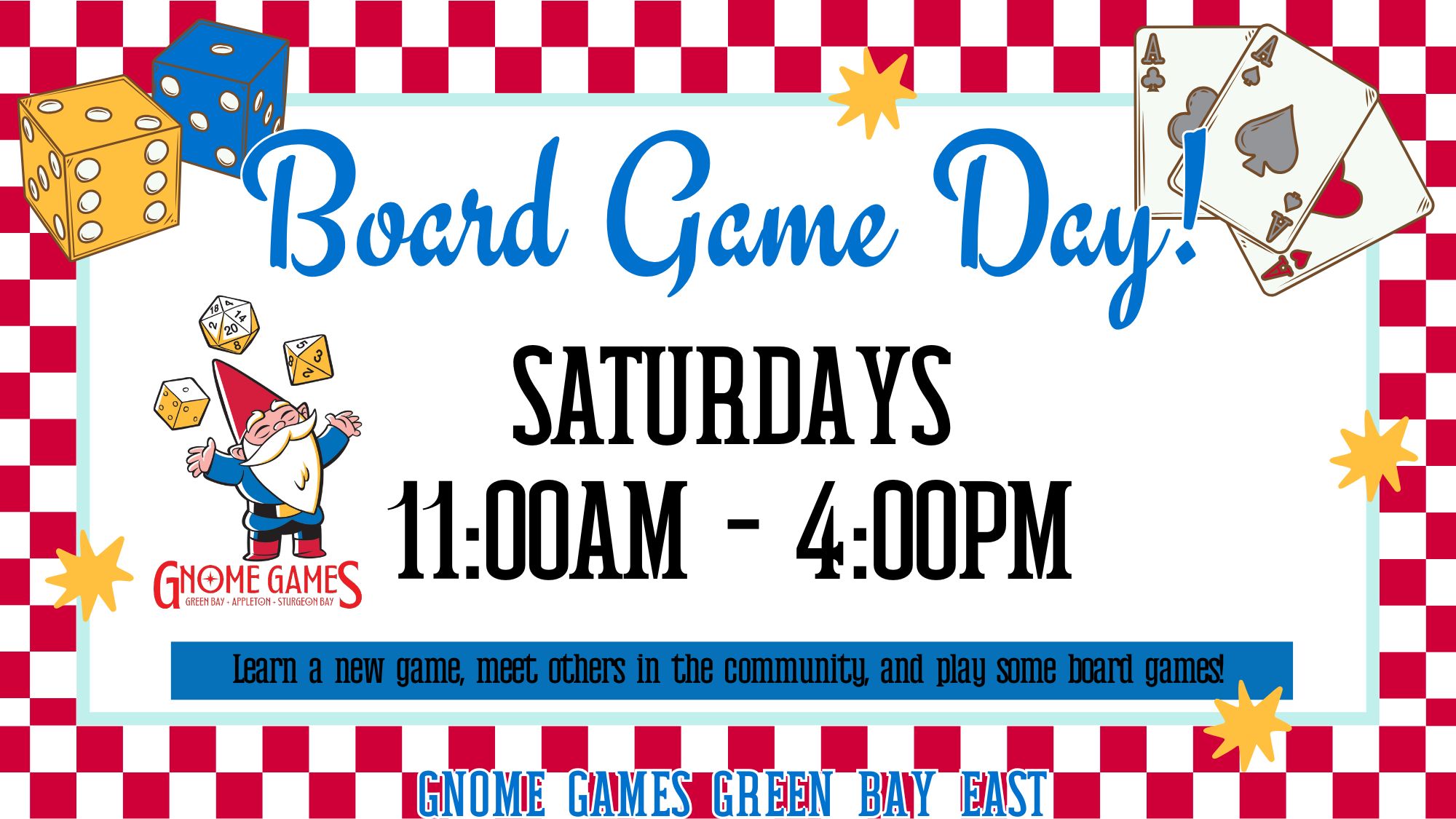
Gnome Games Green Bay East invites you to play games at the table!
Open Play Board Games available to play! Bring your families and friends, grab a table and a game and have some fun!
Starts at 11am
Tons of board games to play in our library or bring your own!
We also have Gnomes who will be demoing games so check out our social media for sneak peaks at what might be the featured game!
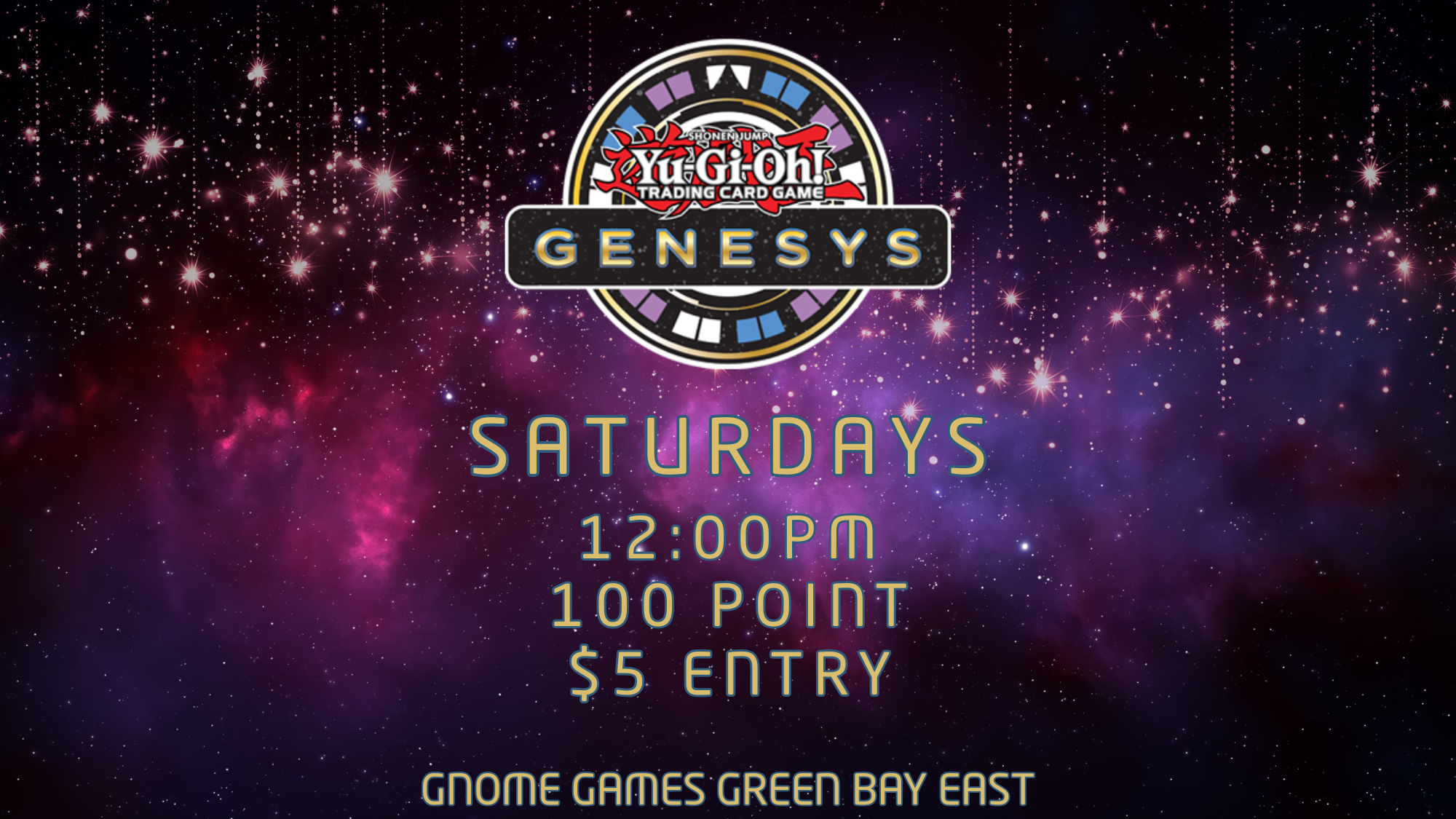
 Yu-Gi-Oh! Genesys is at Gnome Games Green Bay East on Saturdays!
The latest format for Yu-Gi-Oh! Genesys has arrived at Gnome Games! We’re hosting Saturday tournaments each week at 12:00pm for this new format, with $5+tax entry. Like our Advanced Format tournaments it is Win-A-Match, Win-A-Pack, with OTS packs being up for grabs!
But what is Genesys?
A new format of play and deck building that allows for more potential cards to be used!
The Genesys rules are simple:
-
- No Link Monsters or Pendulum Monsters are allowed. All other cards are allowed. The original field layout is used, with no Extra Monster Zones nor Pendulum Zones.
- The standard Forbidden & Limited Cards list is not used. All those cards can be used, except Link Monsters and Pendulum Monsters. Usual limit of 3 copies max of any card still applies.
- Deck construction uses a point system. Some cards are assigned a point value; most cards cost zero points. The total point cost of cards in your Main Deck, Extra Deck, and Side Deck (combined) cannot exceed the point cap for that event.
- The standard point cap is 100, but events can be run with any point cap, or even a zero-point cap! Official Tournament Stores can set their own caps for their tournaments.
Gnome Games is using the standard point cap of 100 for these tournaments. The 100 point cap is geared towards allowing players to use some otherwise Forbidden cards, but attempts to limit “First Turn Kills” that would otherwise be reliable because of their strength.
Konami developed a tool to help with deck construction in the Genesys format, available here:
There’s also a blog to help with learning this new format, as well as to keep up with changes as the point system gets adjusted!
Watch for this and other events on our calendar
Yu-Gi-Oh! Genesys is at Gnome Games Green Bay East on Saturdays!
The latest format for Yu-Gi-Oh! Genesys has arrived at Gnome Games! We’re hosting Saturday tournaments each week at 12:00pm for this new format, with $5+tax entry. Like our Advanced Format tournaments it is Win-A-Match, Win-A-Pack, with OTS packs being up for grabs!
But what is Genesys?
A new format of play and deck building that allows for more potential cards to be used!
The Genesys rules are simple:
-
- No Link Monsters or Pendulum Monsters are allowed. All other cards are allowed. The original field layout is used, with no Extra Monster Zones nor Pendulum Zones.
- The standard Forbidden & Limited Cards list is not used. All those cards can be used, except Link Monsters and Pendulum Monsters. Usual limit of 3 copies max of any card still applies.
- Deck construction uses a point system. Some cards are assigned a point value; most cards cost zero points. The total point cost of cards in your Main Deck, Extra Deck, and Side Deck (combined) cannot exceed the point cap for that event.
- The standard point cap is 100, but events can be run with any point cap, or even a zero-point cap! Official Tournament Stores can set their own caps for their tournaments.
Gnome Games is using the standard point cap of 100 for these tournaments. The 100 point cap is geared towards allowing players to use some otherwise Forbidden cards, but attempts to limit “First Turn Kills” that would otherwise be reliable because of their strength.
Konami developed a tool to help with deck construction in the Genesys format, available here:
There’s also a blog to help with learning this new format, as well as to keep up with changes as the point system gets adjusted!
Watch for this and other events on our calendar
Yu-Gi-Oh! Genesys is at Gnome Games Green Bay East on Saturdays!
The latest format for Yu-Gi-Oh! Genesys has arrived at Gnome Games! We’re hosting Saturday tournaments each week at 12:00pm for this new format, with $5+tax entry. Like our Advanced Format tournaments it is Win-A-Match, Win-A-Pack, with OTS packs being up for grabs!
But what is Genesys?
A new format of play and deck building that allows for more potential cards to be used!
The Genesys rules are simple:
-
- No Link Monsters or Pendulum Monsters are allowed. All other cards are allowed. The original field layout is used, with no Extra Monster Zones nor Pendulum Zones.
- The standard Forbidden & Limited Cards list is not used. All those cards can be used, except Link Monsters and Pendulum Monsters. Usual limit of 3 copies max of any card still applies.
- Deck construction uses a point system. Some cards are assigned a point value; most cards cost zero points. The total point cost of cards in your Main Deck, Extra Deck, and Side Deck (combined) cannot exceed the point cap for that event.
- The standard point cap is 100, but events can be run with any point cap, or even a zero-point cap! Official Tournament Stores can set their own caps for their tournaments.
Gnome Games is using the standard point cap of 100 for these tournaments. The 100 point cap is geared towards allowing players to use some otherwise Forbidden cards, but attempts to limit “First Turn Kills” that would otherwise be reliable because of their strength.
Konami developed a tool to help with deck construction in the Genesys format, available here:
There’s also a blog to help with learning this new format, as well as to keep up with changes as the point system gets adjusted!
Watch for this and other events on our calendar
Yu-Gi-Oh! Genesys is at Gnome Games Green Bay East on Saturdays!
The latest format for Yu-Gi-Oh! Genesys has arrived at Gnome Games! We’re hosting Saturday tournaments each week at 12:00pm for this new format, with $5+tax entry. Like our Advanced Format tournaments it is Win-A-Match, Win-A-Pack, with OTS packs being up for grabs!
But what is Genesys?
A new format of play and deck building that allows for more potential cards to be used!
The Genesys rules are simple:
-
- No Link Monsters or Pendulum Monsters are allowed. All other cards are allowed. The original field layout is used, with no Extra Monster Zones nor Pendulum Zones.
- The standard Forbidden & Limited Cards list is not used. All those cards can be used, except Link Monsters and Pendulum Monsters. Usual limit of 3 copies max of any card still applies.
- Deck construction uses a point system. Some cards are assigned a point value; most cards cost zero points. The total point cost of cards in your Main Deck, Extra Deck, and Side Deck (combined) cannot exceed the point cap for that event.
- The standard point cap is 100, but events can be run with any point cap, or even a zero-point cap! Official Tournament Stores can set their own caps for their tournaments.
Gnome Games is using the standard point cap of 100 for these tournaments. The 100 point cap is geared towards allowing players to use some otherwise Forbidden cards, but attempts to limit “First Turn Kills” that would otherwise be reliable because of their strength.
Konami developed a tool to help with deck construction in the Genesys format, available here:
There’s also a blog to help with learning this new format, as well as to keep up with changes as the point system gets adjusted!
Watch for this and other events on our calendar
Yu-Gi-Oh! Genesys is at Gnome Games Green Bay East on Saturdays!
The latest format for Yu-Gi-Oh! Genesys has arrived at Gnome Games! We’re hosting Saturday tournaments each week at 12:00pm for this new format, with $5+tax entry. Like our Advanced Format tournaments it is Win-A-Match, Win-A-Pack, with OTS packs being up for grabs!
But what is Genesys?
A new format of play and deck building that allows for more potential cards to be used!
The Genesys rules are simple:
-
- No Link Monsters or Pendulum Monsters are allowed. All other cards are allowed. The original field layout is used, with no Extra Monster Zones nor Pendulum Zones.
- The standard Forbidden & Limited Cards list is not used. All those cards can be used, except Link Monsters and Pendulum Monsters. Usual limit of 3 copies max of any card still applies.
- Deck construction uses a point system. Some cards are assigned a point value; most cards cost zero points. The total point cost of cards in your Main Deck, Extra Deck, and Side Deck (combined) cannot exceed the point cap for that event.
- The standard point cap is 100, but events can be run with any point cap, or even a zero-point cap! Official Tournament Stores can set their own caps for their tournaments.
Gnome Games is using the standard point cap of 100 for these tournaments. The 100 point cap is geared towards allowing players to use some otherwise Forbidden cards, but attempts to limit “First Turn Kills” that would otherwise be reliable because of their strength.
Konami developed a tool to help with deck construction in the Genesys format, available here:
There’s also a blog to help with learning this new format, as well as to keep up with changes as the point system gets adjusted!
Watch for this and other events on our calendar
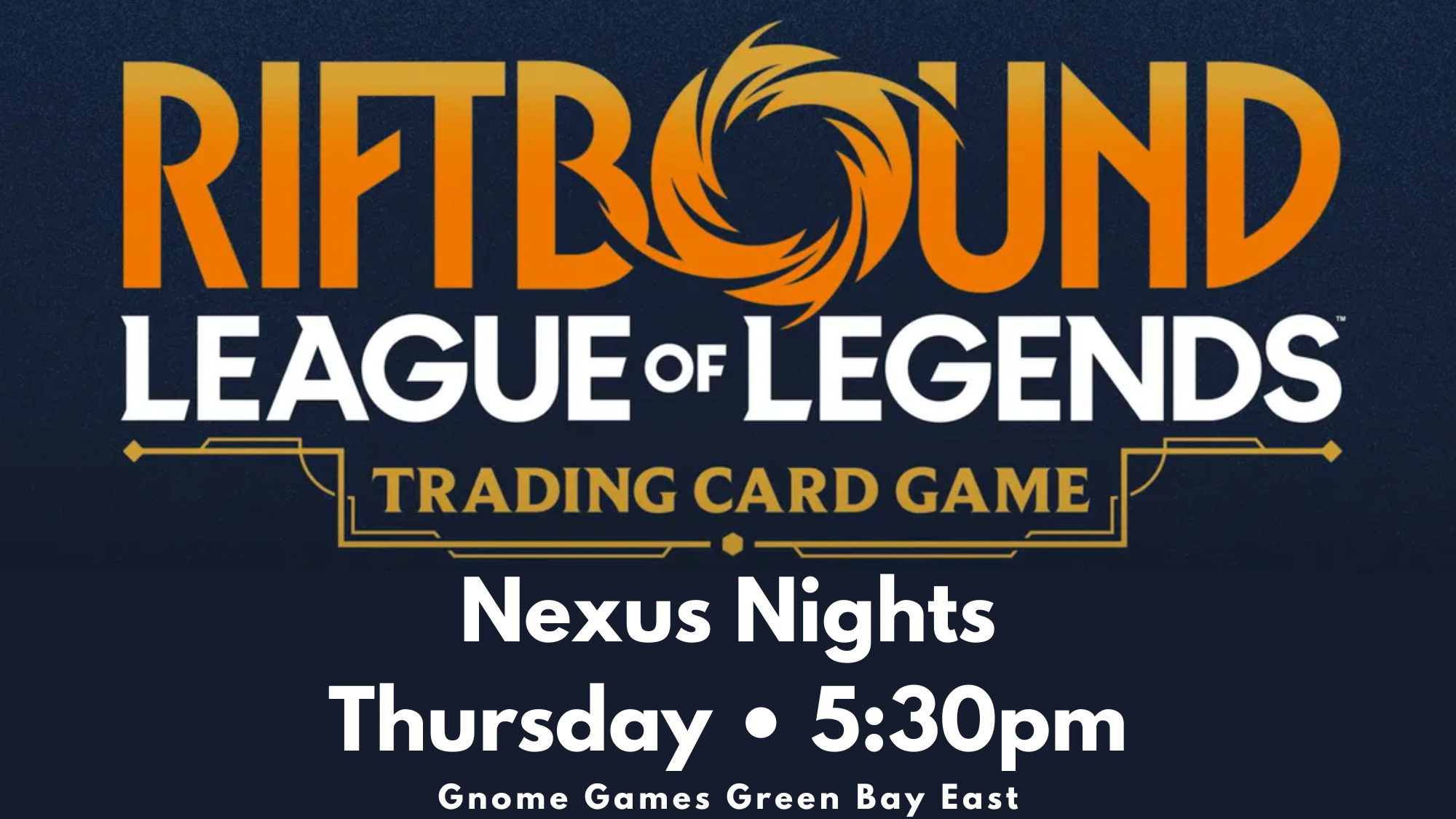
Join the Gnomes each Thursday at 5:30pm for Riftbound’s Nexus Nights!
Tournaments starting at 5:30pm
Entry is $10
Win a Match Win a Pack, Riftbound Promos
Join us weekly for some fun Riftbound action.
The domains are:
- Fury (Red) –
- Fury is about aggression, passion, and the thrill of conquering.
- Fury decks often use damage-based removal, Accelerate (and other ways to enter ready), and rewards for conquering to achieve victory.
- Generally, Fury cards have a harder time drawing lots of cards or killing units directly, especially units that stay out of combat in their base.
- Examples of Fury from popular fiction are Conan the Barbarian, Blade, and Anakin Skywalker.
- Calm (Green) –
- Calm is about balance, meditation, and the peace of holding.
- Calm decks often use defensive tricks, moving enemies, and negating interaction (like counterspells and stuns) to defend their holds and achieve victory.
- Generally, Calm cards have a harder time being very aggressive or interacting without using their units.
- Examples of Calm from popular fiction are Gandalf, Baloo, and Obi Wan Kenobi.
- Mind (Blue) –
- Mind is about innovation, outsmarting opponents, and the benefits of intelligence and curiosity.
- Mind decks often use long-term planning, shrinking tricks, card draw, hidden and gear synergy to gain an advantage and achieve victory.
- Generally, Mind cards have a harder time with moving units or having efficient units.
- Examples of Mind from popular fiction are Sherlock Holmes, Curious George, and Yoda.
- Body (Orange) –
- Body is about physical superiority, agility, and connection to the wilds.
- Body decks often ramp their resources, play efficient and high impact units, and dominate combats to achieve victory.
- Generally, Body cards have a harder time with finding efficient card draw or noncombat spells.
- Examples of Body from popular fiction are The Terminator, Juggernaut, and Chewbacca.
- Chaos (Purple) –
- Chaos is about unpredictability, rebellion, and trickiness.
- Chaos decks often manipulate position and the trash, use hidden tricks, and filter toward the right cards to achieve victory.
- Generally, Chaos cards have a harder time permanently eliminating a threat or giving permanent advantages to its units.
- Examples of Chaos from popular fiction are V (for Vendetta), Spiderman, and Han Solo.
- Order (Yellow) –
- Order is about unity, community, and sacrifice for the greater good.
- Order decks often generate many small units, gain effects on unit death, and kill units directly to achieve victory.
- Generally, Order cards have a harder time dealing with smaller units and moving units.
- Examples of Order from popular fiction are Superman, Cobra Commander, and Leia Organa.
One way to start building a deck is to start with a domain you think fits your playstyle (or just style, generally) and search for cool cards you might want to fit into a deck.
Look for this and other events at our website: gnomegames.com/events/month!
Join the Gnomes each Thursday at 5:30pm for Riftbound’s Nexus Nights!
Tournaments starting at 5:30pm
Entry is $10
Win a Match Win a Pack, Riftbound Promos
Join us weekly for some fun Riftbound action.
The domains are:
- Fury (Red) –
- Fury is about aggression, passion, and the thrill of conquering.
- Fury decks often use damage-based removal, Accelerate (and other ways to enter ready), and rewards for conquering to achieve victory.
- Generally, Fury cards have a harder time drawing lots of cards or killing units directly, especially units that stay out of combat in their base.
- Examples of Fury from popular fiction are Conan the Barbarian, Blade, and Anakin Skywalker.
- Calm (Green) –
- Calm is about balance, meditation, and the peace of holding.
- Calm decks often use defensive tricks, moving enemies, and negating interaction (like counterspells and stuns) to defend their holds and achieve victory.
- Generally, Calm cards have a harder time being very aggressive or interacting without using their units.
- Examples of Calm from popular fiction are Gandalf, Baloo, and Obi Wan Kenobi.
- Mind (Blue) –
- Mind is about innovation, outsmarting opponents, and the benefits of intelligence and curiosity.
- Mind decks often use long-term planning, shrinking tricks, card draw, hidden and gear synergy to gain an advantage and achieve victory.
- Generally, Mind cards have a harder time with moving units or having efficient units.
- Examples of Mind from popular fiction are Sherlock Holmes, Curious George, and Yoda.
- Body (Orange) –
- Body is about physical superiority, agility, and connection to the wilds.
- Body decks often ramp their resources, play efficient and high impact units, and dominate combats to achieve victory.
- Generally, Body cards have a harder time with finding efficient card draw or noncombat spells.
- Examples of Body from popular fiction are The Terminator, Juggernaut, and Chewbacca.
- Chaos (Purple) –
- Chaos is about unpredictability, rebellion, and trickiness.
- Chaos decks often manipulate position and the trash, use hidden tricks, and filter toward the right cards to achieve victory.
- Generally, Chaos cards have a harder time permanently eliminating a threat or giving permanent advantages to its units.
- Examples of Chaos from popular fiction are V (for Vendetta), Spiderman, and Han Solo.
- Order (Yellow) –
- Order is about unity, community, and sacrifice for the greater good.
- Order decks often generate many small units, gain effects on unit death, and kill units directly to achieve victory.
- Generally, Order cards have a harder time dealing with smaller units and moving units.
- Examples of Order from popular fiction are Superman, Cobra Commander, and Leia Organa.
One way to start building a deck is to start with a domain you think fits your playstyle (or just style, generally) and search for cool cards you might want to fit into a deck.
Look for this and other events at our website: gnomegames.com/events/month!
Join the Gnomes each Thursday at 5:30pm for Riftbound’s Nexus Nights!
Tournaments starting at 5:30pm
Entry is $10
Win a Match Win a Pack, Riftbound Promos
Join us weekly for some fun Riftbound action.
The domains are:
- Fury (Red) –
- Fury is about aggression, passion, and the thrill of conquering.
- Fury decks often use damage-based removal, Accelerate (and other ways to enter ready), and rewards for conquering to achieve victory.
- Generally, Fury cards have a harder time drawing lots of cards or killing units directly, especially units that stay out of combat in their base.
- Examples of Fury from popular fiction are Conan the Barbarian, Blade, and Anakin Skywalker.
- Calm (Green) –
- Calm is about balance, meditation, and the peace of holding.
- Calm decks often use defensive tricks, moving enemies, and negating interaction (like counterspells and stuns) to defend their holds and achieve victory.
- Generally, Calm cards have a harder time being very aggressive or interacting without using their units.
- Examples of Calm from popular fiction are Gandalf, Baloo, and Obi Wan Kenobi.
- Mind (Blue) –
- Mind is about innovation, outsmarting opponents, and the benefits of intelligence and curiosity.
- Mind decks often use long-term planning, shrinking tricks, card draw, hidden and gear synergy to gain an advantage and achieve victory.
- Generally, Mind cards have a harder time with moving units or having efficient units.
- Examples of Mind from popular fiction are Sherlock Holmes, Curious George, and Yoda.
- Body (Orange) –
- Body is about physical superiority, agility, and connection to the wilds.
- Body decks often ramp their resources, play efficient and high impact units, and dominate combats to achieve victory.
- Generally, Body cards have a harder time with finding efficient card draw or noncombat spells.
- Examples of Body from popular fiction are The Terminator, Juggernaut, and Chewbacca.
- Chaos (Purple) –
- Chaos is about unpredictability, rebellion, and trickiness.
- Chaos decks often manipulate position and the trash, use hidden tricks, and filter toward the right cards to achieve victory.
- Generally, Chaos cards have a harder time permanently eliminating a threat or giving permanent advantages to its units.
- Examples of Chaos from popular fiction are V (for Vendetta), Spiderman, and Han Solo.
- Order (Yellow) –
- Order is about unity, community, and sacrifice for the greater good.
- Order decks often generate many small units, gain effects on unit death, and kill units directly to achieve victory.
- Generally, Order cards have a harder time dealing with smaller units and moving units.
- Examples of Order from popular fiction are Superman, Cobra Commander, and Leia Organa.
One way to start building a deck is to start with a domain you think fits your playstyle (or just style, generally) and search for cool cards you might want to fit into a deck.
Look for this and other events at our website: gnomegames.com/events/month!
Join the Gnomes each Thursday at 5:30pm for Riftbound’s Nexus Nights!
Tournaments starting at 5:30pm
Entry is $10
Win a Match Win a Pack, Riftbound Promos
Join us weekly for some fun Riftbound action.
The domains are:
- Fury (Red) –
- Fury is about aggression, passion, and the thrill of conquering.
- Fury decks often use damage-based removal, Accelerate (and other ways to enter ready), and rewards for conquering to achieve victory.
- Generally, Fury cards have a harder time drawing lots of cards or killing units directly, especially units that stay out of combat in their base.
- Examples of Fury from popular fiction are Conan the Barbarian, Blade, and Anakin Skywalker.
- Calm (Green) –
- Calm is about balance, meditation, and the peace of holding.
- Calm decks often use defensive tricks, moving enemies, and negating interaction (like counterspells and stuns) to defend their holds and achieve victory.
- Generally, Calm cards have a harder time being very aggressive or interacting without using their units.
- Examples of Calm from popular fiction are Gandalf, Baloo, and Obi Wan Kenobi.
- Mind (Blue) –
- Mind is about innovation, outsmarting opponents, and the benefits of intelligence and curiosity.
- Mind decks often use long-term planning, shrinking tricks, card draw, hidden and gear synergy to gain an advantage and achieve victory.
- Generally, Mind cards have a harder time with moving units or having efficient units.
- Examples of Mind from popular fiction are Sherlock Holmes, Curious George, and Yoda.
- Body (Orange) –
- Body is about physical superiority, agility, and connection to the wilds.
- Body decks often ramp their resources, play efficient and high impact units, and dominate combats to achieve victory.
- Generally, Body cards have a harder time with finding efficient card draw or noncombat spells.
- Examples of Body from popular fiction are The Terminator, Juggernaut, and Chewbacca.
- Chaos (Purple) –
- Chaos is about unpredictability, rebellion, and trickiness.
- Chaos decks often manipulate position and the trash, use hidden tricks, and filter toward the right cards to achieve victory.
- Generally, Chaos cards have a harder time permanently eliminating a threat or giving permanent advantages to its units.
- Examples of Chaos from popular fiction are V (for Vendetta), Spiderman, and Han Solo.
- Order (Yellow) –
- Order is about unity, community, and sacrifice for the greater good.
- Order decks often generate many small units, gain effects on unit death, and kill units directly to achieve victory.
- Generally, Order cards have a harder time dealing with smaller units and moving units.
- Examples of Order from popular fiction are Superman, Cobra Commander, and Leia Organa.
One way to start building a deck is to start with a domain you think fits your playstyle (or just style, generally) and search for cool cards you might want to fit into a deck.
Look for this and other events at our website: gnomegames.com/events/month!